In youth football, many children learn to execute before they learn to understand.
They follow instructions, repeat patterns, and avoid mistakes — not because they read the game well, but because they are afraid to fail.
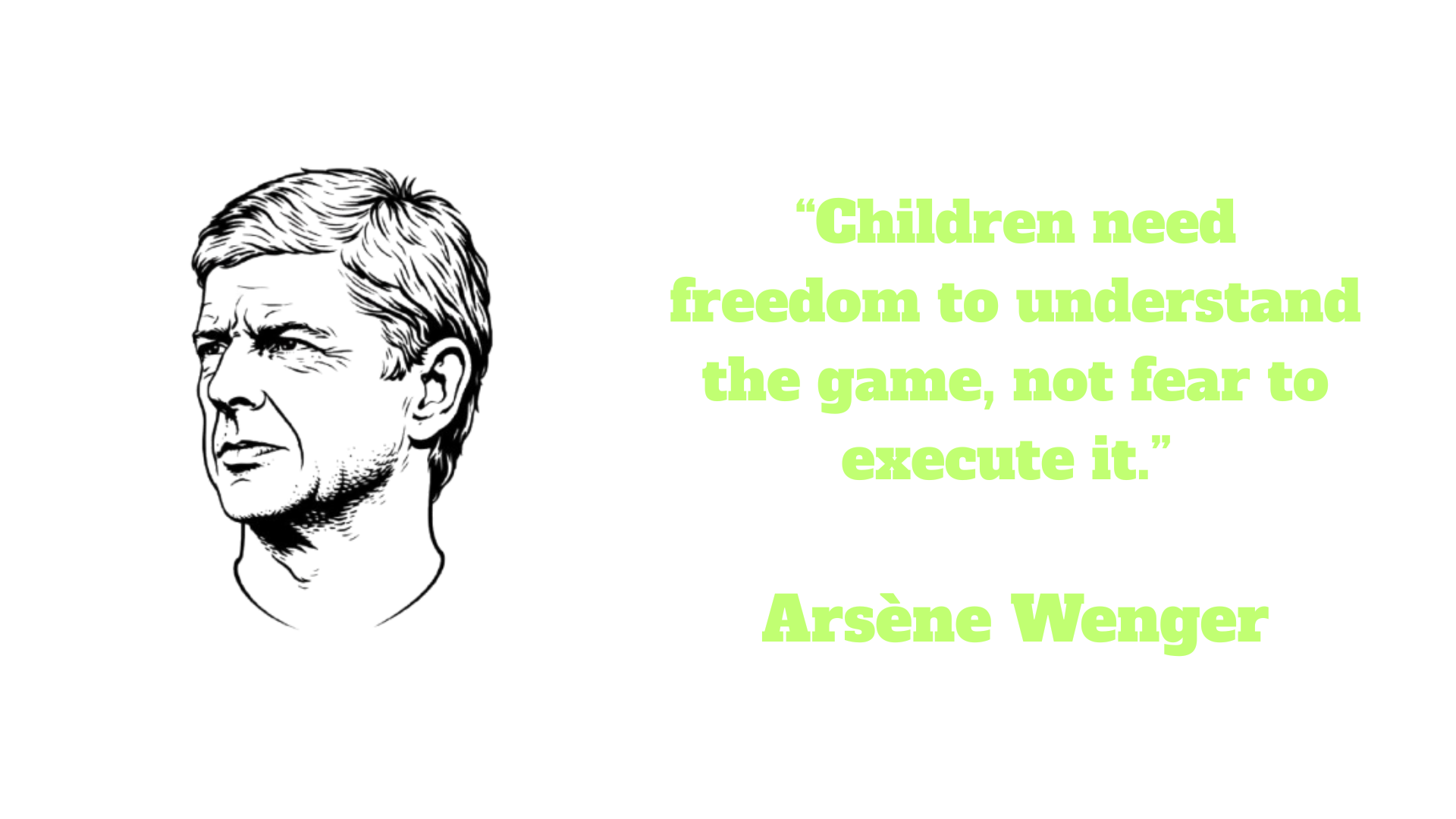
Arsène Wenger highlights a fundamental truth of player development:
children need freedom to understand the game, not fear to execute it.
Football intelligence does not grow under fear.
It grows under freedom.
Fear creates obedience, not understanding
When children play with fear:
-
they look to the bench before acting;
-
they choose the safest option every time;
-
they avoid responsibility;
-
they stop thinking creatively.
Fear may produce short-term order, but it blocks learning.
Execution without understanding is fragile — it collapses under pressure.
Why freedom leads to game intelligence
Freedom allows children to:
-
observe the game;
-
interpret situations;
-
make decisions based on context;
-
learn from consequences.
A child who is free to decide:
-
develops game awareness;
-
builds confidence;
-
understands why an action works;
-
becomes adaptable.
Understanding comes from experience, not commands.
Wenger’s long-term vision
Arsène Wenger has always defended intelligent, expressive football.
His philosophy is rooted in the belief that players must understand the game before mastering execution.
This approach starts early by:
-
prioritizing thinking over rigid positioning;
-
allowing mistakes as part of learning;
-
encouraging initiative;
-
reducing fear-based coaching.
Great players are not built by control, but by trust.
The coach’s responsibility: remove fear
A youth coach shapes not only skills, but mindset.
To help children understand the game, the coach must:
-
create a safe learning environment;
-
react calmly to mistakes;
-
ask questions instead of giving orders;
-
reward ideas, not just outcomes.
When fear disappears, curiosity appears.
And curiosity is the foundation of learning.
Freedom does not mean chaos
Freedom in football does not mean a lack of structure.
It means clear principles with space for interpretation.
Children learn best when they know:
-
the objective;
-
the basic rules;
-
that they are trusted to find solutions.
Inside that structure, freedom allows understanding to emerge.
Conclusion
Arsène Wenger’s quote defines a core principle of youth football:
understanding grows where fear is absent.
If we want players who read the game, adapt, and think independently, we must replace fear with freedom.
Because football is not about perfect execution —
it is about intelligent decision-making in real situations.