In youth football, education does not come from rigid rules or constant correction.
It comes from freedom — the freedom to explore, to try, and to create.
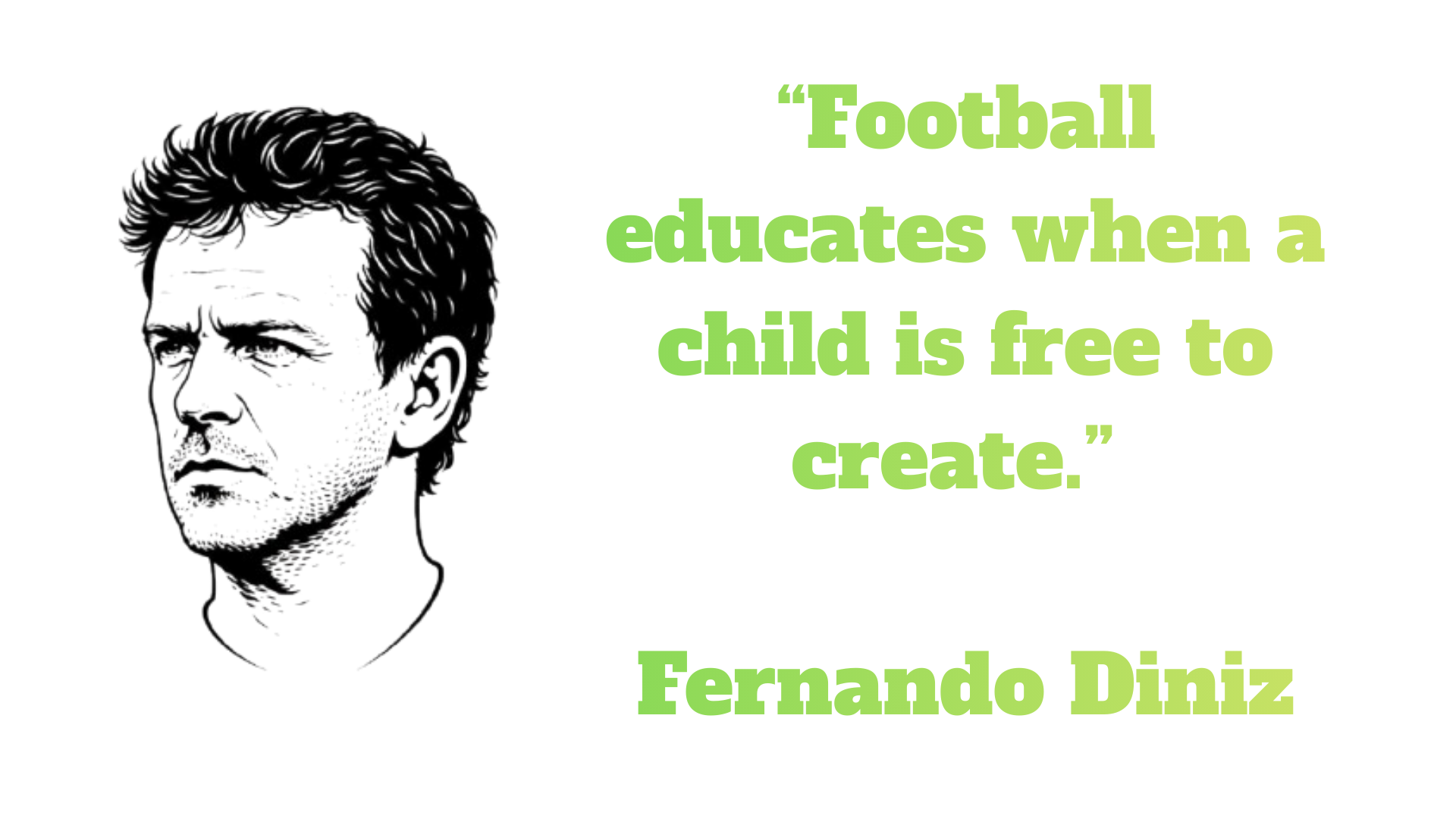
Fernando Diniz, one of the strongest advocates of creative and player-centered football, expresses a fundamental principle: football truly educates when a child is free to create.
Without freedom, football becomes repetition.
With freedom, football becomes learning.
Why creativity is essential in child development
Children learn best when they are allowed to:
-
experiment with solutions;
-
express themselves through the ball;
-
make choices without fear;
-
transform imagination into action.
Creativity activates thinking, emotion, and curiosity at the same time.
This is the deepest form of learning.
A child who is free to create:
-
develops game intelligence;
-
builds confidence;
-
understands the game intuitively;
-
enjoys the learning process.
When freedom disappears, learning stops
In overly controlled environments:
-
children play to avoid mistakes;
-
creativity is replaced by obedience;
-
initiative fades;
-
fear replaces joy.
Football may still look “organized,” but education is lost.
Players execute movements, but they don’t understand them.
True education requires autonomy.
Diniz and the courage to let players think
Fernando Diniz’s philosophy is based on:
-
decision-making freedom;
-
responsibility with the ball;
-
trust in the player;
-
learning through real game situations.
He understands that creativity is not chaos.
It is guided freedom, built inside clear principles.
Children who are trusted learn to trust themselves.
The coach as an educator, not a controller
A youth coach who educates does not dictate every action.
He creates an environment where thinking is unavoidable.
In practice, this means:
-
game-based exercises;
-
rules that encourage options, not patterns;
-
space to make mistakes;
-
questions instead of constant instructions.
The coach teaches by allowing discovery, not by giving answers.
Creativity builds complete players
Players educated through freedom:
-
adapt faster to new contexts;
-
make better decisions under pressure;
-
retain a love for the game;
-
grow both as players and as people.
Creativity is not an extra.
It is a core competence of modern football.
Conclusion
Fernando Diniz’s quote defines a powerful educational truth:
football educates when children are free to create.
If we want intelligent, confident, and expressive players, we must give them freedom — within a supportive structure.
Because football is not just about playing correctly.
It is about thinking freely.