
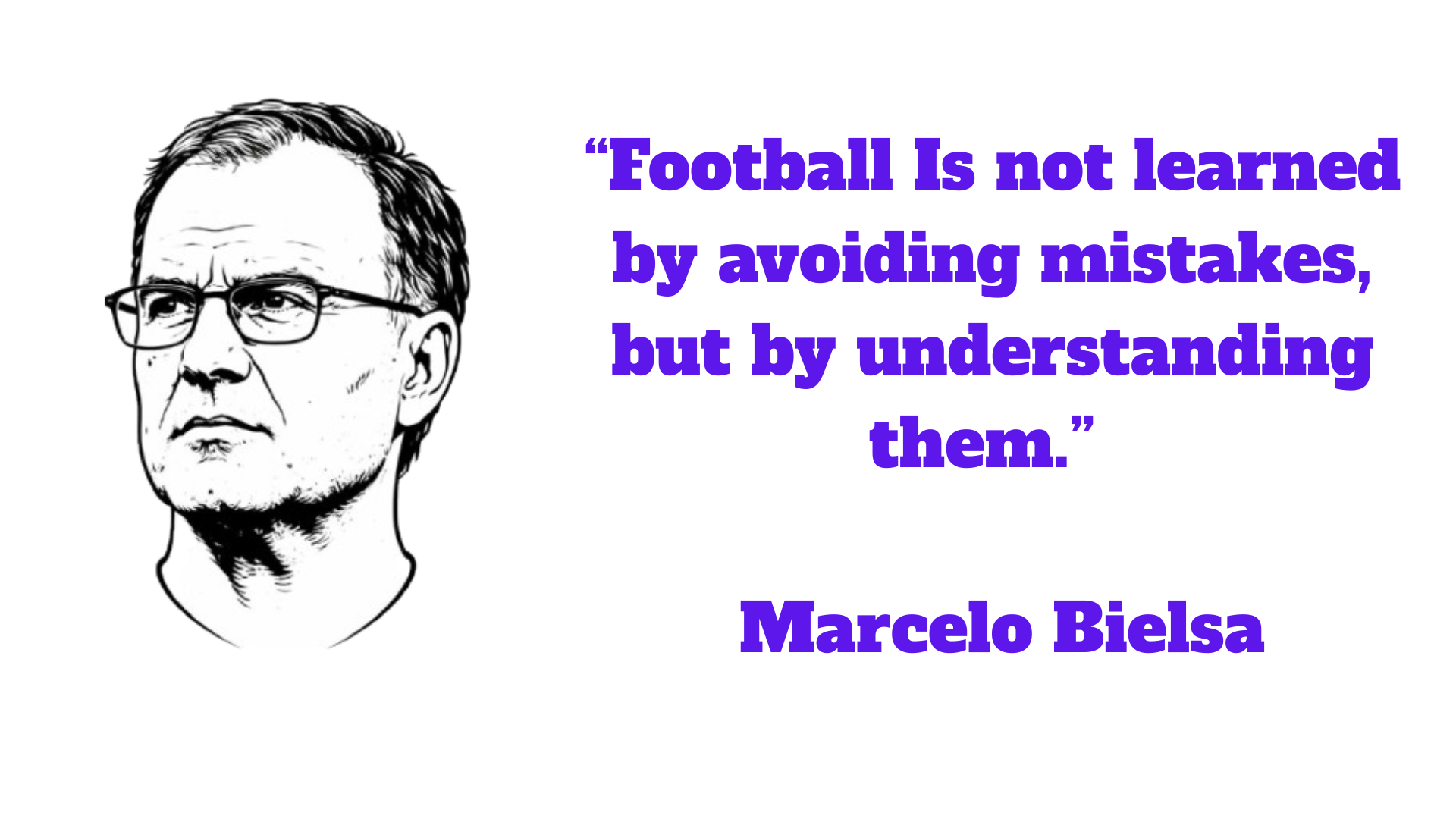
In youth football, mistakes are often treated as something negative — something to eliminate, hide, or punish.
Marcelo Bielsa offers a radically different and deeply educational perspective: football is not learned by avoiding mistakes, but by understanding them.
Mistakes are not the opposite of learning.
They are the starting point of learning.
Why mistakes are essential for real learning
Football is a game of constant decisions.
Every decision carries risk — and where there is risk, mistakes are inevitable.
When a child makes a mistake and is allowed to reflect on it, they learn:
-
what they saw;
-
why they chose that option;
-
what alternatives were available;
-
how to adjust next time.
This process develops:
-
game intelligence;
-
decision-making ability;
-
emotional resilience;
-
confidence under pressure.
Avoiding mistakes may look “clean,” but it produces fragile players.
The danger of mistake-avoidance
When children are coached to avoid mistakes at all costs:
-
they choose the safest option every time;
-
they stop taking initiative;
-
creativity disappears;
-
fear replaces curiosity.
The player may look disciplined, but learning is blocked.
Execution improves, but understanding does not.
Bielsa’s message is clear: football education cannot be built on fear.
Understanding comes after experience
Marcelo Bielsa has always emphasized learning through experience.
For him, mistakes are not failures — they are information.
A child who understands a mistake:
-
will not repeat it blindly;
-
will adapt faster;
-
will make better decisions in new situations.
This kind of learning cannot be taught through instructions alone.
It must be lived on the pitch.
The coach’s role: transform mistakes into lessons
A youth coach should not rush to correct every error.
Instead, the coach should:
-
observe calmly;
-
ask questions;
-
guide reflection;
-
adjust the training context.
Questions like:
-
“What did you see?”
-
“Why did you choose that option?”
-
“What could you try next time?”
These questions turn mistakes into learning moments.
Mistakes build intelligent players
Players who are allowed to make and understand mistakes:
-
become adaptable;
-
read the game better;
-
take responsibility;
-
develop autonomy.
They don’t fear the ball.
They don’t fear decisions.
They trust the learning process.
Conclusion
Marcelo Bielsa’s quote captures a fundamental truth of youth football:
progress does not come from avoiding mistakes, but from understanding them.
If we want intelligent, creative, and resilient players, we must allow mistakes — and teach children how to learn from them.
Because football, like life, is learned not by perfection,
but by experience and reflection.