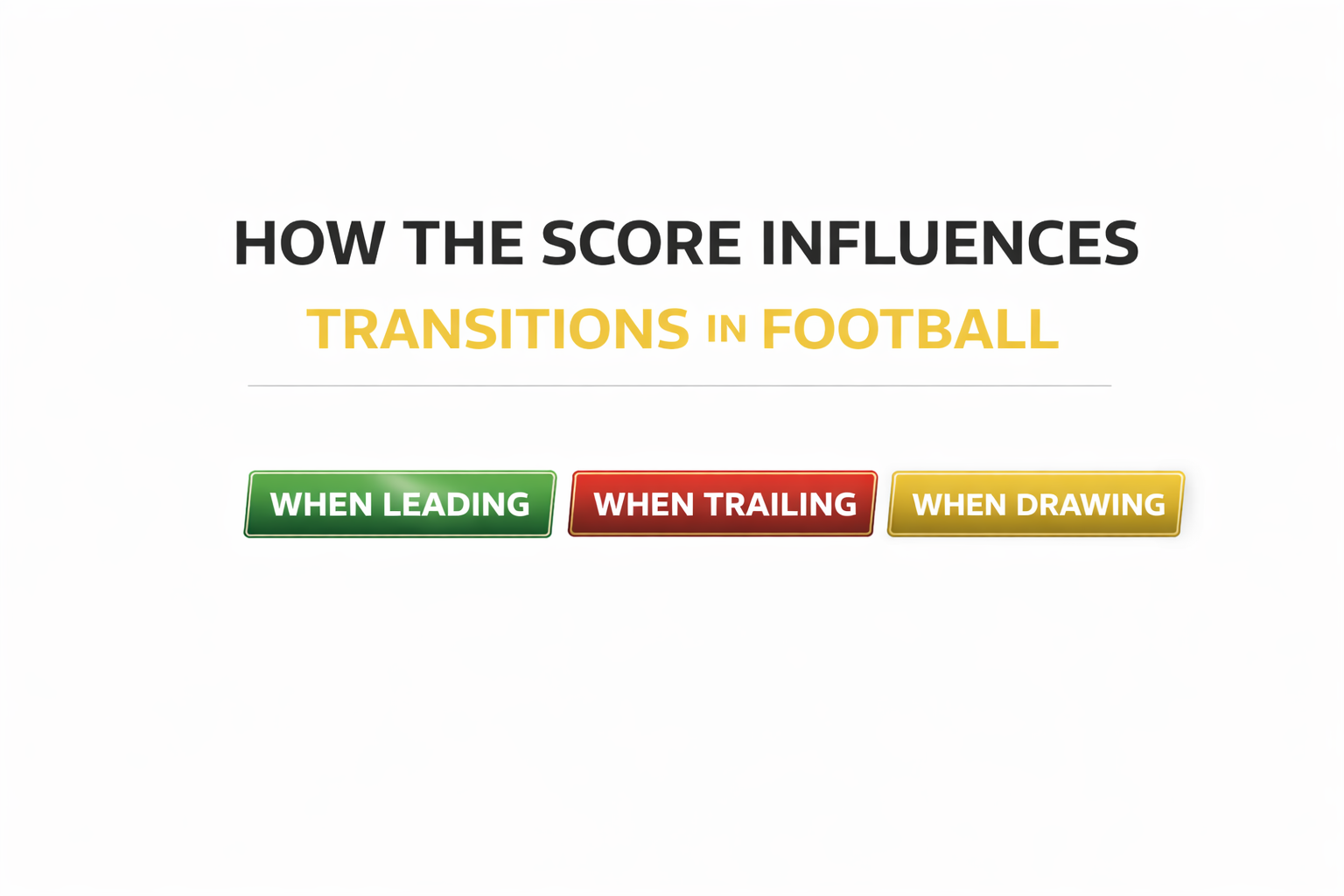
In football, transitions are influenced not only by space, time, or positioning, but also by the scoreline. The same moment of play requires completely different decisions when you are leading compared to when you are trailing. Mature teams understand this and adapt their transitions to manage the game, not just react instinctively.
This article is based on key ideas that are easy to apply and explains how the score changes priorities, tempo, and risk during transitions.
1. Why the score influences transitions
The score modifies:
-
the level of acceptable risk;
-
emotional behavior;
-
time management;
-
the immediate objective of the game.
Transitions are tactical decisions, not automatic reactions.
2. Transitions when you are leading
When you have the advantage on the scoreboard, the main objective becomes game control.
Clear priorities:
-
reducing risk;
-
securing possession;
-
maintaining defensive structure.
In the negative transition:
-
selective pressing, not aggressive;
-
protecting the central areas;
-
quick compactness.
In the positive transition:
-
do not force the attack;
-
choose safe solutions;
-
gain time through possession.
When you are leading, control is more valuable than spectacle.

3. Common mistakes when leading
-
unnecessary acceleration after recovery;
-
chaotic pressing in search of “security”;
-
quick losses that bring the opponent back into the game.
The desire to “finish the match” often leads to losing control.
4. Transitions when you are trailing
When you are behind, the objective changes: quick ball recovery and progression.
Clear priorities:
-
increasing intensity;
-
accepting calculated risk;
-
greater verticality.
In the negative transition:
-
more aggressive pressing;
-
attempts to recover the ball higher up the pitch;
-
reducing the opponent’s decision time.
In the positive transition:
-
quick decision-making;
-
attacking space;
-
earlier finishing.
When you are trailing, tempo becomes a weapon.
5. Common mistakes when trailing
-
pressing without structure;
-
accelerating out of frustration;
-
neglecting central protection.
Urgency without organization produces chaos, not goals.
6. Transitions when the score is level
A level score is the zone of intelligent decisions.
Mature teams:
-
read the moment of the game;
-
alternate acceleration with control;
-
manage their energy.
A draw does not mean neutrality—it means continuous adaptation.
7. The role of leaders in managing transitions based on the score
Leaders (centre-backs, defensive midfielders, goalkeepers):
-
transmit calm or urgency;
-
regulate the tempo;
-
influence collective decisions.
The team follows the tone of its leaders, not only the instructions from the bench.
8. How to train transitions according to the score
For coaches:
-
small-sided games with simulated scorelines;
-
different rules when leading or trailing;
-
different scoring systems in the final minutes;
-
feedback focused on decision-making, not only results.
If you do not train the score context, you will manage it chaotically during matches.
Conclusion for coaches
The score changes the game, and transitions are the first aspect that must adapt.
A mature team:
-
knows when to slow the game down;
-
knows when to take risks;
-
manages emotions and structure.
Transitions are not the same when you are leading or trailing. And that must be trained.