
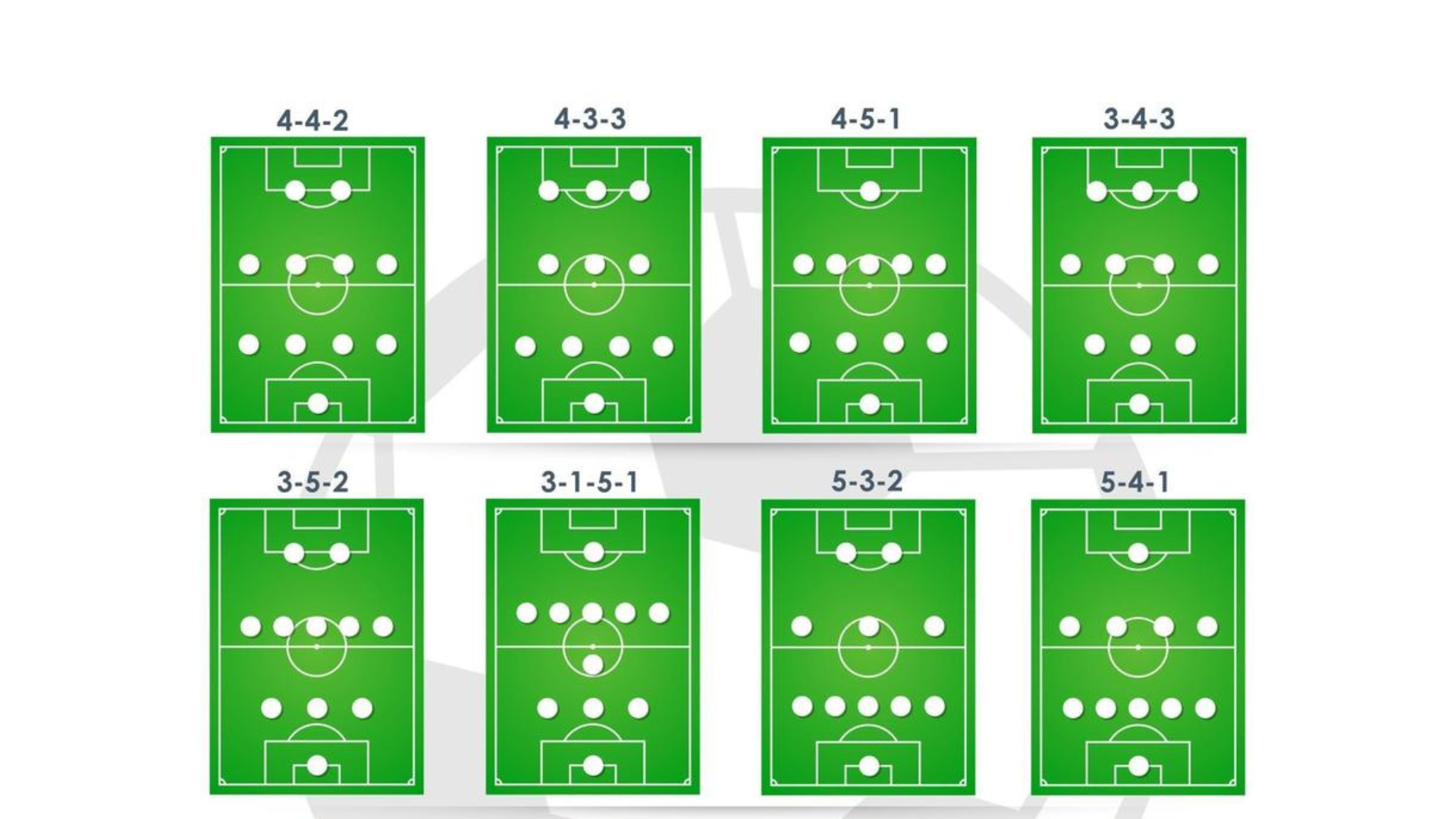
Choosing the right playing system is not about following trends — it’s a strategic decision that shapes your team’s identity, efficiency, and long-term development. A formation is not just a drawing on a tactics board; it is a structure that defines how your players interact, occupy space, and express their strengths.
For many coaches, the real question is not “Which system is the best?” but “Which system fits my team?”
In this article, you’ll find a clear, practical, and professional approach to choosing the ideal system for your squad.
1. Analyze your players’ profiles
Every system must start with the players — not the other way around. Ask yourself:
-
Are your centre-backs fast or strong in duels?
-
Are your midfielders creative playmakers or ball-winners?
-
Do you have wingers who attack 1v1 or who drift inside?
-
Is your striker a target man or a combination player?
The best system is the one that highlights the strengths of most players, not just one superstar.
Examples:
-
Two hardworking but not very creative midfielders → 4-4-2 gives balance.
-
A smart no. 10 and two technical wingers → 4-2-3-1 is ideal.
-
Very offensive full-backs → 3-5-2 or 3-4-3 becomes extremely effective.
2. Consider the tactical maturity of your team
The complexity of the system must match the level of your players.
-
Younger or less experienced teams → simple structures with clear roles (4-3-3, 4-4-2).
-
Advanced or senior teams → hybrid systems with rotations and flexible roles (4-2-3-1, 3-2-5, 3-4-2-1).
A system that’s too complicated leads to confusion, poor spacing, and easy goals conceded.
3. Align the system with your game model
A formation is only a skeleton. Your game model gives it life.
-
Want possession and progression through central areas? → 4-3-3 or 4-2-3-1.
-
Prefer verticality and counter-attacks? → 4-4-2 or 4-5-1.
-
Rely on wing-play with high full-backs? → 3-5-2 or 3-4-3.
-
Build with high pressing and compactness? → systems with 3 central players + aggressive wingers.
Your system must support your coaching philosophy.
4. Study your competition and opponents
You shouldn’t change the system every week, but it must help you:
-
balance duels in key zones,
-
create superiorities where needed,
-
protect your team’s weaknesses.
Example:
If most opponents use a classic 4-4-2 → a 4-3-3 gives you natural superiority in midfield.
If opponents have very fast wingers → a back three provides defensive stability.
5. Test the system in training first
Before using it in official matches:
-
introduce it in small-sided games (6v6, 8v8),
-
build simple principles: spacing, triangles, distances,
-
analyse how fast your players adapt.
The right system feels natural — players find solutions quicker and the team moves as a unit.
6. Be flexible: The starting shape ≠ The playing shape
In modern football:
-
attacking and defensive shapes look different,
-
teams switch systems in real time (4-2-3-1 → 2-3-5 in attack, 4-4-2 in defence),
-
the best systems allow mobility and adaptability.
Don’t be trapped by the drawing before kick-off.
Coach principles, not positions.
Conclusion
Choosing the right system is not a theoretical exercise. It is a practical decision based on the qualities of your players, your philosophy as a coach, and the way your team trains.
A good system creates clarity, highlights strengths, and builds a cohesive identity.
There is no perfect formation — but there is a perfect formation for your team.