
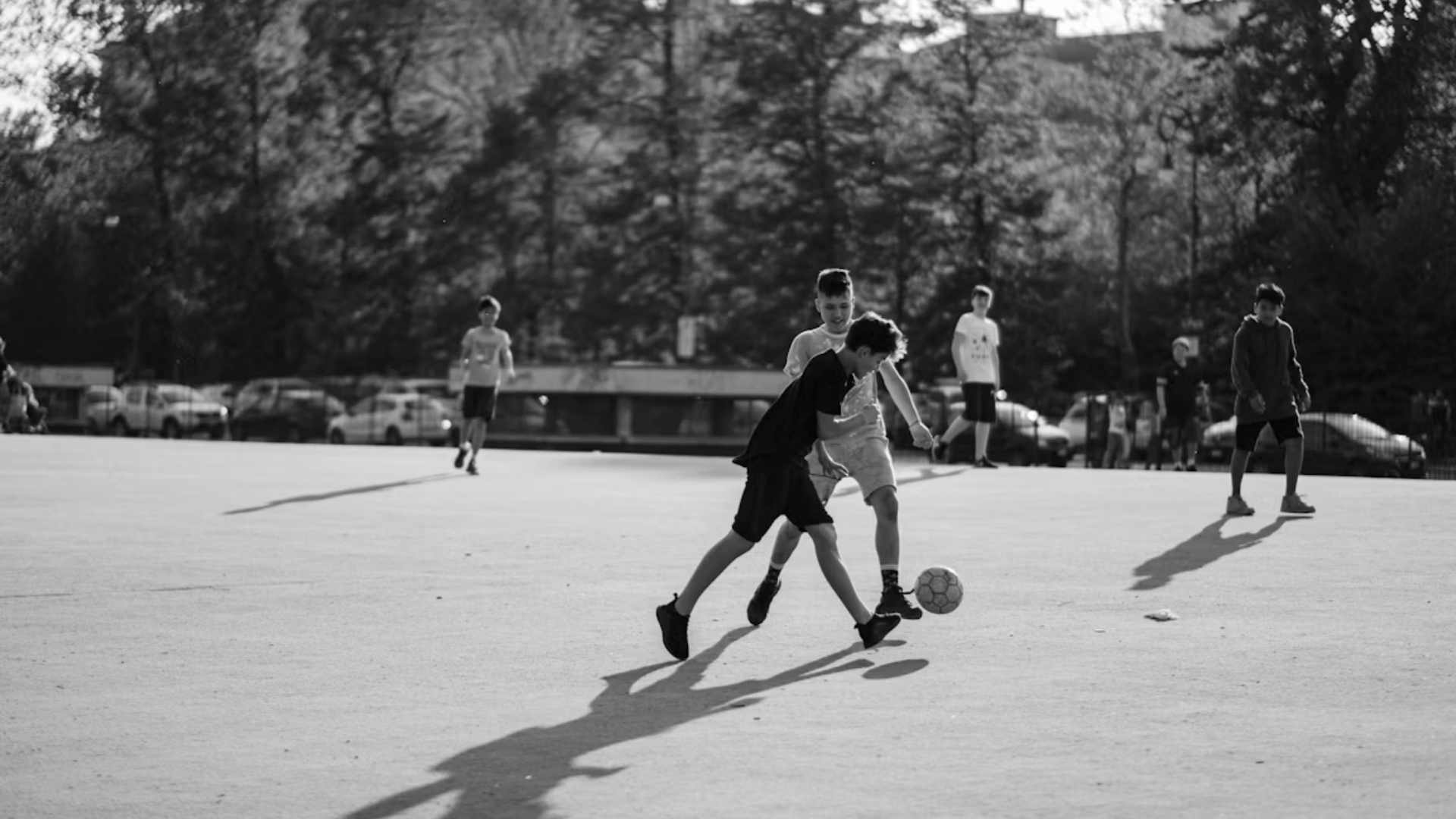
There was no official starting date for the season, no participation fee and no registration form. You did not need a complete kit or a coach’s recommendation. All you had to do was turn up on the street, ask who was playing and wait to be selected for one of the teams.
Two stones became goalposts, the road became a football pitch, and one old ball could bring every child in the neighbourhood together.
Street football was an academy open to everyone.
The game was the teacher
Nobody stopped the game to explain every mistake. Children tried something, lost the ball, recognised what had gone wrong and tried again.
If a dribble failed, the next attempt had to be quicker. If a pass struck a stone or rolled underneath a car, the child learned to look up and anticipate. If the opponent was older and stronger, a solution had to be found through technique, intelligence or speed.
The learning was not organised into drills, but it was constant. Every action created a problem, and every problem required a decision.

Creativity grew from imperfect conditions
The pitch was not level, the goals were not always the same size, and the ball never bounced perfectly. Parked cars, kerbs, potholes and walls became obstacles—or even part of the game itself.
Children had to adapt.
In tight spaces, they learned to protect the ball. On uneven surfaces, they adjusted their control and balance. Against older opponents, they discovered the importance of thinking quickly. The rules changed according to the number of players and the space available.
The conditions were imperfect, but those imperfections stimulated imagination and helped develop intelligent, adaptable players.
There was no substitutes’ bench
In street football, every child had a place. The most talented, the youngest, the slowest and the newcomer could all participate in the same game.
The teams were not always balanced, but solutions were found. If one team became too strong, a player moved to the opposition. If another child arrived, the rules were adjusted. If someone had to go home, the match continued in a different format.
Children were not judged according to how many minutes they deserved to play. They played—and participation helped them improve.
This natural form of inclusion made every child feel part of the group. They were not merely tolerated. They were needed for the match to continue.
No referee, but plenty of responsibility
Every match had its controversial moments. Was it a foul? Did the ball pass between the stones? Was it handball? Sometimes the discussion lasted longer than the incident itself.
There was no referee to provide an immediate decision. The children had to defend their point of view, listen to one another and find a compromise.
Not every dispute was resolved perfectly. However, one shared motivation was stronger than the desire to be right: everyone wanted the game to continue.
Street football therefore developed communication, self-control, negotiation and a sense of fairness. Children learned that dishonest behaviour could destroy the trust of the entire group.
Defeat did not mean exclusion
Losing could hurt, but it did not remove a child from the game. There was no fear of being left on the bench for the next match and no label suggesting that someone was not good enough.
Most of the time, the rematch began a few minutes later—or the following day.
Children learned to lose, accept their friends’ jokes and ask for the ball again. A mistake was an experience, not an identity. Defeat was an invitation to return, not a reason to give up.
That was how resilience developed: through the opportunity to fall and immediately re-enter the game.
What can organised football learn?
We should not send children back onto unsafe streets or reject the advantages of modern pitches and organised coaching.
However, we can recover some of the principles of that academy that required no registration:
-
More time for free play.
-
Fewer interventions during every action.
-
Teams and rules adapted by the children.
-
Practices that allow multiple solutions.
-
Meaningful opportunities for every participant.
-
The freedom to make mistakes and try again.
-
Moments when the coach observes before providing the answer.
The coach remains important, but should not become the only source of solutions. Sometimes the most valuable intervention is to create the right environment and allow the game to teach the children.
One ball, two stones and a thousand lessons
Street football did not provide perfect conditions. It provided time, freedom, belonging and real problems to solve.
Children were not only learning how to pass, dribble or score. They were learning how to communicate, share, adapt, lose, recover and find their own place within a team.
Not all of those lessons could be measured through statistics. Yet many remained with the child long after the match had finished.
Street football had no changing rooms, coaches or registration fees. Nevertheless, for many generations, it was their first—and perhaps their most important—football academy.
Which lesson learned on the street do you believe is most absent from children’s football today?
#FootballOfYesteryear #StreetFootball #YouthFootball #ChildDevelopment #LearningThroughPlay #EnjoyCoach