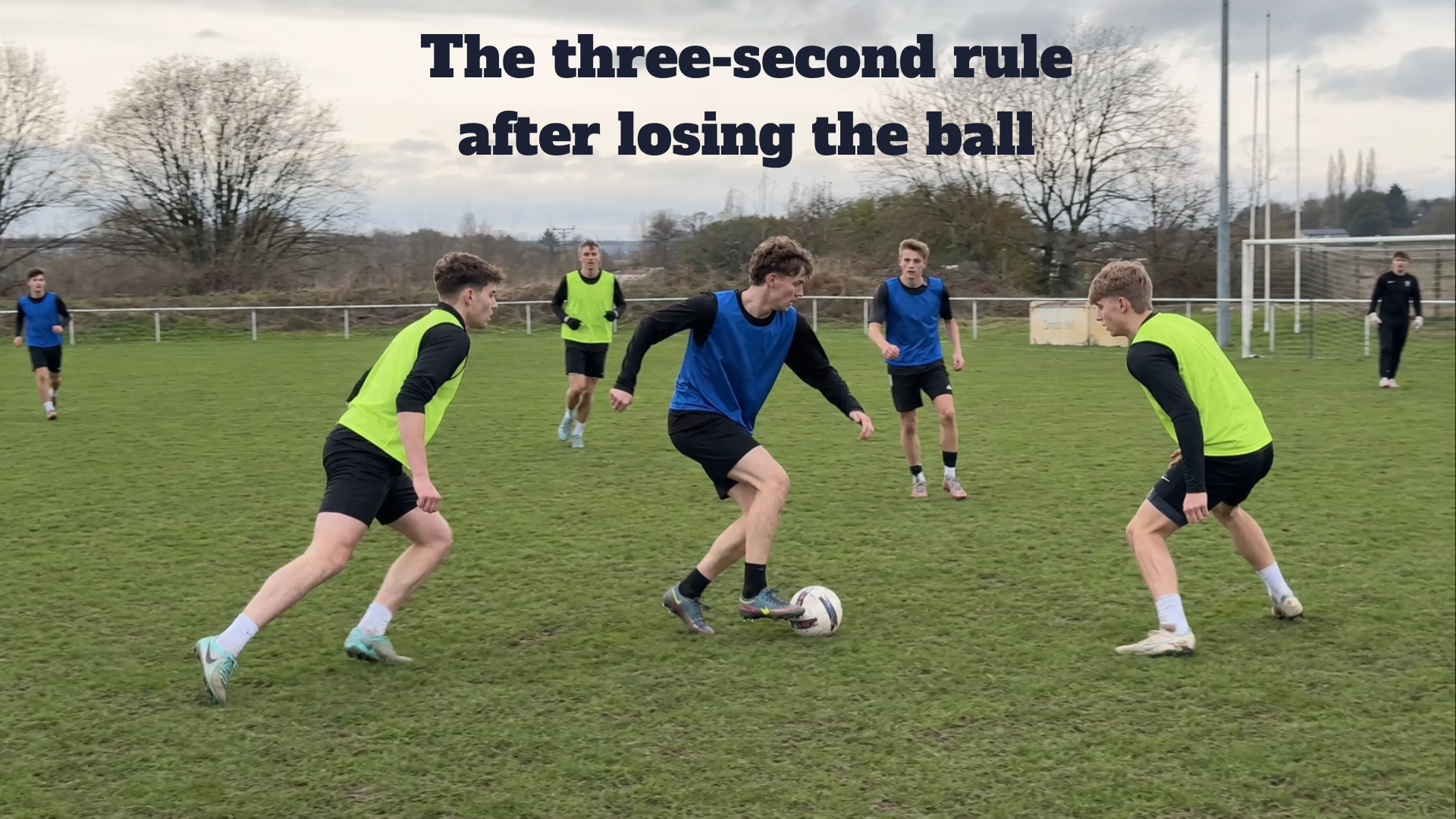
Losing the ball does not represent the end of an attack, but the beginning of a new collective action. The first few seconds are decisive because the opponent who has just regained possession is not yet organised offensively, while the player on the ball may have only a few passing options available.
The three-second rule requires the team to react immediately after losing possession. During this short period, the players closest to the ball must apply pressure, limit the opponent’s options and, when the situation allows, attempt to regain possession quickly.
However, this rule does not mean that every player should run directly towards the ball. The reaction must be organised, with clearly defined roles:
- The first player pressures the ball carrier.
- The nearby players close down the available passing options.
- The other players reduce the distances between the lines.
- The players positioned behind the action protect the central area and the space in behind.
The objective is not always to regain possession immediately. If the opponent is forced to play backwards, sideways or into a less dangerous area, the reaction has already achieved an important part of its purpose. The team gains time to reorganise and prevents the opponent from launching a counterattack.
When can it be applied?
Immediate pressing is effective when the ball is lost in an area where the team has enough players nearby. Short distances allow the team to close down the space quickly and reduce the opponent’s available options.
However, if the team is unbalanced, the players are too far apart or the opponent has already managed to play forward, continuing to press can become risky. In this situation, the priority should be to recover defensive positions and restore the team’s organisation.
After approximately three seconds, the team must make a collective decision: continue pressing if there is a realistic chance of regaining possession, or stop chasing the ball without purpose and reorganise behind it.
A rule that shapes the team’s mentality
The three-second rule does more than develop tactical behaviours. It creates a proactive, responsible team that is prepared to react. Players begin to understand that losing the ball is not the main problem. The real problem appears when the team remains passive after losing it.
The message given to the players should be simple:
We lose the ball, we react together. If we cannot regain it quickly, we reorganise together.
A good team is not one that never loses the ball, but one that knows exactly what to do immediately after losing it.
Common mistakes when applying the three-second rule
One of the most common mistakes is an individual reaction. A single player presses the ball carrier while their teammates remain too far away. In this situation, the press can be easily bypassed, allowing the opposition to exploit the spaces left open.
Another problem occurs when every player runs towards the ball. The team overloads the same area but leaves the centre of the pitch, passing lanes and the space in behind unprotected. An immediate reaction does not mean chasing the ball chaotically. It requires players to coordinate different roles.
Players may also continue pressing even after the opposition has bypassed the initial pressure. Instead of dropping back and rebuilding the defensive block, they continue chasing the ball with little chance of regaining possession. As a result, the distances between the lines increase and the team becomes vulnerable.
Correct application requires players to recognise both the moment to press and the moment to abandon the pressure and reorganise. The three seconds should produce a collective decision, not merely a physical reaction.