In youth football development, one of the biggest mistakes is trying to turn the game into a set of fixed patterns.
Rigid positions. Predefined movements. “Correct” solutions applied regardless of the situation.
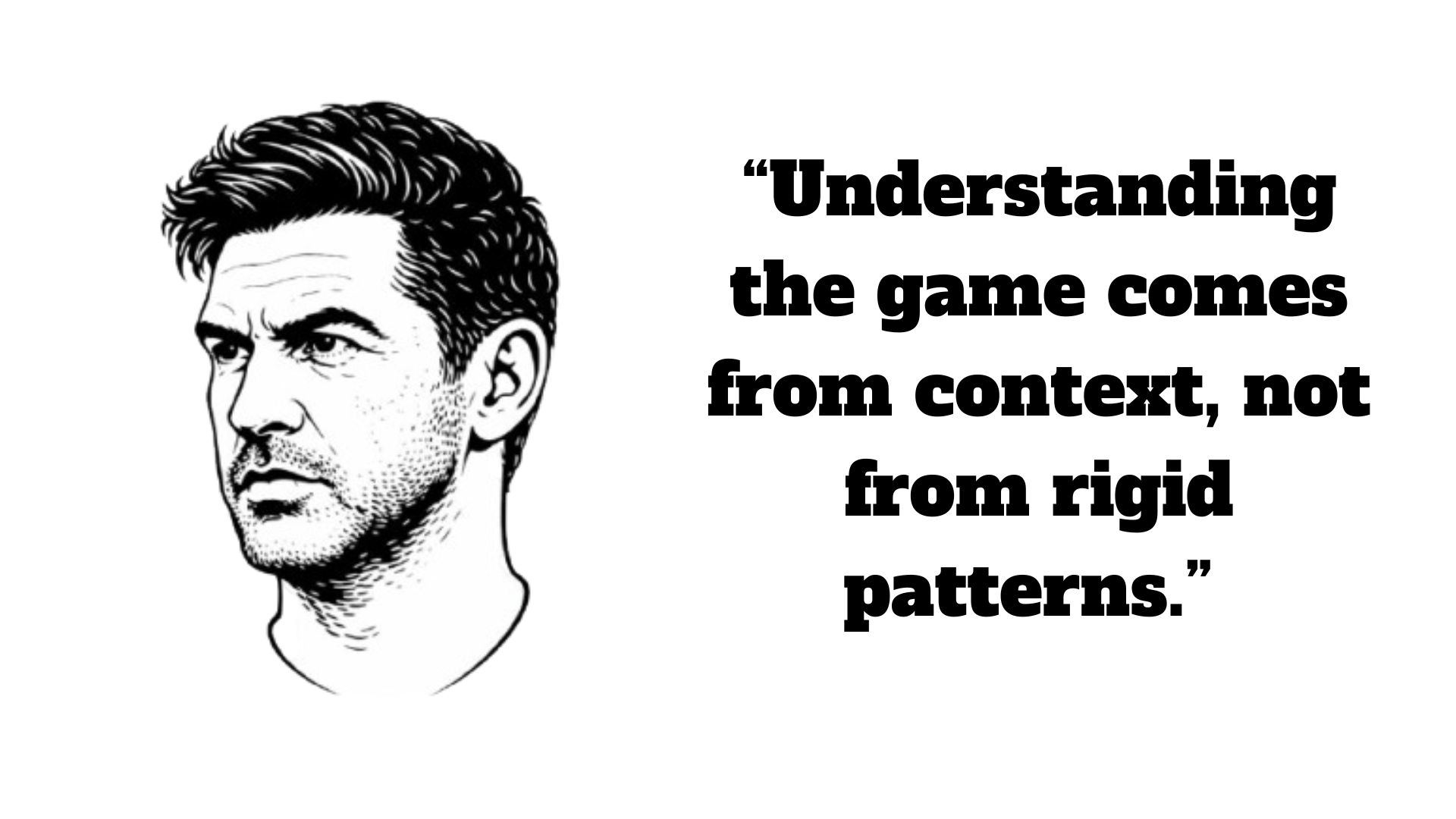
Paulo Fonseca captures a key idea for real player development: understanding the game comes from context, not from rigid patterns.
Football is not a formula that works the same way every time.
It is a game of adaptation.
The game changes every second
Context in football is constantly shifting:
-
the position of the ball;
-
the distance of the opponent;
-
available space;
-
decision-making time;
-
the number of options.
A child who only learns “patterns” will struggle when the context changes.
A child who learns to read the situation will always find solutions.
Why rigid patterns limit thinking
Fixed patterns may offer short-term security, but they:
-
reduce creativity;
-
limit initiative;
-
block autonomous decision-making;
-
create players dependent on instructions.
Instead of thinking what is happening, the child thinks what was taught.
And real football never follows a script.
Context develops game intelligence
An intelligent player is not the one who knows the most patterns, but the one who:
-
recognizes situations quickly;
-
understands risks and advantages;
-
adapts solutions to the moment;
-
makes the right decision under pressure.
This intelligence is not built through theory, but through:
-
real game situations;
-
variable-based exercises;
-
unpredictable scenarios;
-
the freedom to make mistakes and adjust.
The coach’s role: creator of contexts, not robots
A development-focused coach does not tell players what to do in every situation.
He creates the right context for players to discover solutions on their own.
In practice:
-
design exercises with multiple options;
-
use simple rules instead of complex instructions;
-
ask questions that stimulate thinking;
-
accept mistakes as part of the learning process.
This is how players learn to play real football, not “board football.”
Conclusion
Paulo Fonseca’s quote is a modern reference for youth coaching:
football is learned through living contexts, not rigid patterns.
If we want adaptable, intelligent, and creative players, we must teach them to understand the game — not to repeat solutions.
Context changes everything.
And the player who understands the context will always find the right answer.