In youth football, success is often measured in goals, wins, and rankings.
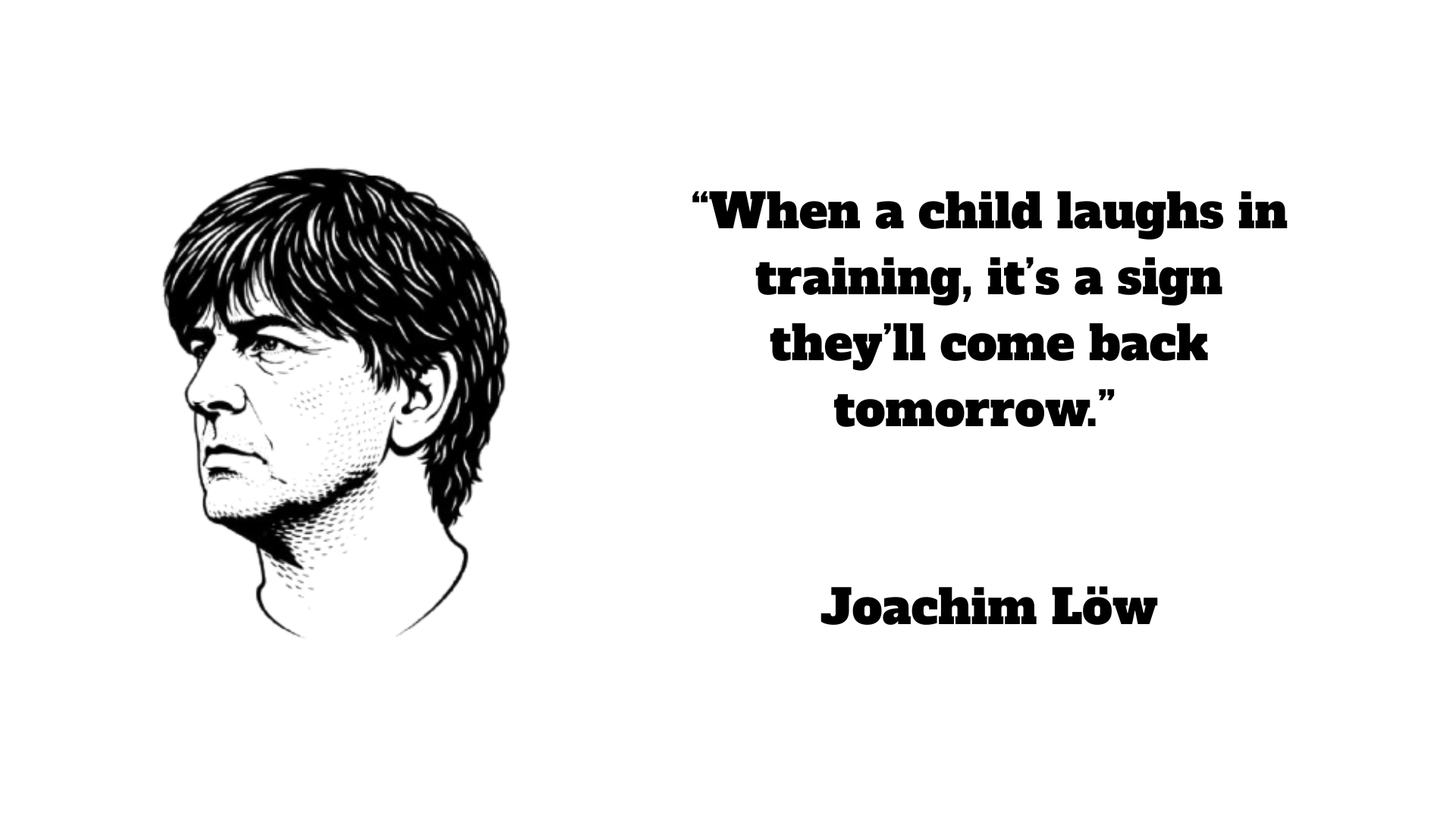
But Joachim Löw highlights a much deeper indicator of long-term development: a child’s smile during training.
When a child laughs, enjoys the session, and feels comfortable on the pitch, it means one essential thing — they want to come back.
And in youth football, continuity is everything.
Why enjoyment guarantees long-term development
Children don’t develop because of one perfect session.
They develop because they:
-
show up consistently;
-
stay motivated over time;
-
associate football with positive emotions.
A child who enjoys training:
-
learns faster;
-
dares to try new things;
-
handles mistakes better;
-
builds a healthy relationship with the game.
Laughter is not a distraction.
It is a signal of engagement.

The link between emotions and learning
Modern sport science confirms what experienced coaches already know:
emotion and learning are inseparable.
Positive emotions:
-
improve attention;
-
increase memory retention;
-
reduce fear of failure;
-
encourage exploration.
When a child feels joy, the brain is open to learning.
When a child feels pressure or fear, learning shuts down.
What happens when training loses joy
When training becomes rigid, tense, or overly serious:
-
children attend out of obligation;
-
motivation decreases;
-
creativity disappears;
-
dropout risk increases.
Many talented players are not lost because of lack of ability,
but because football stopped being fun.
Löw’s message for youth coaches
Joachim Löw’s quote is not about lowering standards.
It’s about understanding priorities.
At young ages, the most important question is not:
“Did they execute perfectly?”
But:
-
Did they enjoy the session?
-
Did they feel valued?
-
Do they want to come back tomorrow?
If the answer is yes, development is already happening.
The coach’s real responsibility
A youth coach is not only responsible for drills and tactics.
He is responsible for the emotional climate of the training session.
That means:
-
creating playful, game-like exercises;
-
encouraging expression and creativity;
-
accepting mistakes as part of learning;
-
building trust instead of fear.
Children don’t remember every exercise.
They remember how football made them feel.
Conclusion
Joachim Löw delivers a simple but powerful truth:
when a child laughs in training, you’ve already won.
Because joy keeps children in the game.
And children who stay in the game are the ones who truly develop.
In youth football, the biggest success is not the result on Saturday —
it’s seeing children return to training with excitement on Monday.