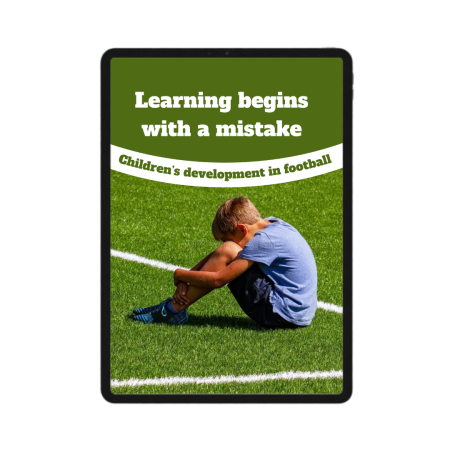
In youth football development, mistakes are often treated as enemies—something to eliminate quickly, correct immediately, or avoid at all costs.
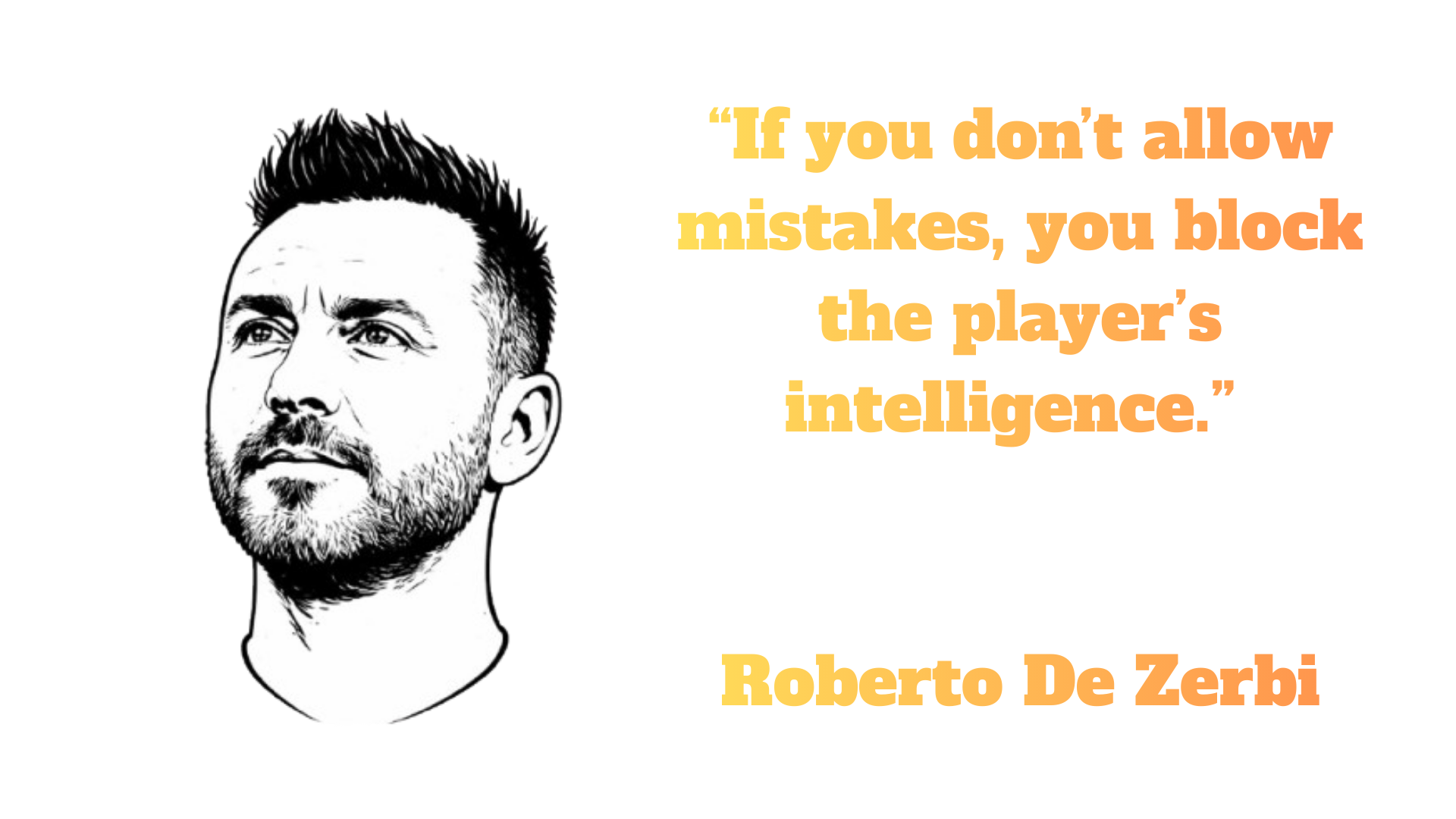
Roberto De Zerbi, one of the coaches who places game intelligence at the center of his philosophy, delivers a clear message: if you don’t allow mistakes, you block the player’s intelligence.
A child who is not allowed to make mistakes will not learn how to think.
They will only learn how to comply.
Mistakes are a condition for thinking
Intelligence in football is not just about knowing solutions. It involves:
-
observation;
-
anticipation;
-
risk evaluation;
-
decision-making under pressure.
All of these processes appear only when a player takes responsibility for decisions.
And every real decision carries the possibility of making a mistake.
Without mistakes, there is no authentic cognitive process.

What happens when mistakes are forbidden
In rigid environments where mistakes are punished:
-
children play “safe”;
-
they avoid creative solutions;
-
they pass without intention;
-
they constantly wait for instructions.
Over time, this creates players who are:
-
dependent on the coach;
-
lacking initiative;
-
unable to adapt to new situations.
Intelligence doesn’t disappear — it is blocked.
De Zerbi and controlled freedom
Roberto De Zerbi promotes a style of football based on:
-
individual responsibility;
-
decision-making freedom;
-
risk-taking;
-
learning through experience.
This freedom does not mean chaos.
It means a clear framework in which players can explore, make mistakes, and self-correct.
That is where intelligent players are formed.
The coach’s role: guide, not censor
A development-focused coach does not react emotionally to every mistake.
Instead, he:
-
observes;
-
asks questions;
-
adjusts the context;
-
allows time for reflection.
The key questions are not “Why did you make that mistake?”
But “What did you see?” and “What could you do next time?”
This approach teaches players to think — not to fear.
Conclusion
Roberto De Zerbi’s quote is a warning for youth football:
intelligence cannot develop in an environment where mistakes are not allowed.
If we want creative, adaptable, intelligent players, we must allow mistakes — not punish them.
Because in football, as in life,
intelligence grows where mistakes are accepted.