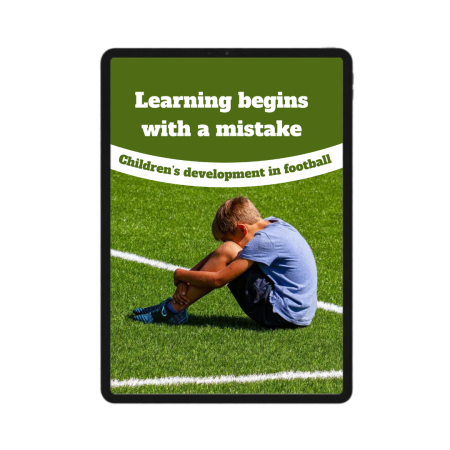

There is an image that every youth football coach should keep in mind. A child receives the ball, attempts a dribble, loses possession, and a few seconds later asks for the ball again with a smile on their face. Not because they don't care about making mistakes, but because they feel free enough to try again.
On another pitch, a child makes exactly the same mistake. But their reaction is different. They immediately look towards the coach, expecting criticism, and during the next action, they choose to pass backwards. They are no longer looking for the best solution, but for the one that will protect them from being criticised.
Both children lost the ball. But only one continues to play without fear.
In youth football, we talk a great deal about technique, tactics, intensity, and discipline. We design exercises, plan training sessions, and analyse every detail of the game. Yet sometimes we forget that, before they are footballers, the players we coach are children. And how they feel on the pitch can profoundly influence how they learn.
A child who arrives at training with enthusiasm is often more willing to explore, ask questions, and embrace challenges. They are not afraid to try a new skill, take on an opponent, or discover a different solution. Every successful action builds confidence, while every mistake can become a valuable learning experience.
On the other hand, when training is dominated by fear, a child's attention can shift away from the game and towards the reactions of adults. Instead of observing opponents and identifying spaces, they begin worrying about what will happen if they lose the ball. Instead of making their own decisions, they constantly wait for instructions. And when avoiding mistakes becomes the main objective, creativity and initiative begin to suffer.
Paradoxically, such a child may appear extremely disciplined. They follow instructions, avoid unnecessary risks, and rarely step outside the coach's expectations. But we must ask ourselves whether they are truly learning to understand the game or simply learning to obey commands from the touchline.
Football is a game in which situations change constantly. No coach can anticipate every problem a player will encounter. That is precisely why children must be encouraged to observe, think, and make decisions independently. These qualities are more likely to develop in an environment where mistakes are treated as part of the learning process rather than as reasons for humiliation.
This does not mean training sessions should lack discipline or that every child must be praised regardless of their behaviour. Enjoyment does not exclude high standards. A coach can demand concentration, effort, and responsibility without turning every mistake into a moment of tension. They can correct players firmly but respectfully. They can build a competitive team without removing the joy of playing.
In fact, one of the most important qualities of a youth coach is the ability to create an environment where players want to work hard, rather than one where they work hard simply because they are afraid of being criticised.
Sometimes, the difference comes down to a few words. Instead of saying, "How many times do I have to tell you not to do that?", we can ask, "What other option did you have?" Instead of immediately criticising an unsuccessful dribble, we can acknowledge the intention and discuss whether it was the right moment to attempt it.
In this way, the child receives more than a correction.
They learn how to think.
Years from now, most of the children we coach will not remember every exercise they performed or every tactical instruction they received. But they will remember whether they enjoyed coming to training, whether they felt confident enough to try new things, and whether their coach made them believe they were capable of improving.
Perhaps a smile does not tell us everything about the quality of a training session. But it can tell us something important about a child's relationship with the game.
And that relationship deserves to be protected.
Because the purpose of youth football is not simply to develop players who execute instructions correctly, but to develop people who have the confidence to think, make decisions, and try again when things do not go as planned.
A child who smiles during training is not necessarily taking football less seriously. It may mean they feel confident and secure enough to truly learn.
And sometimes, that is one of the greatest victories a coach can achieve.