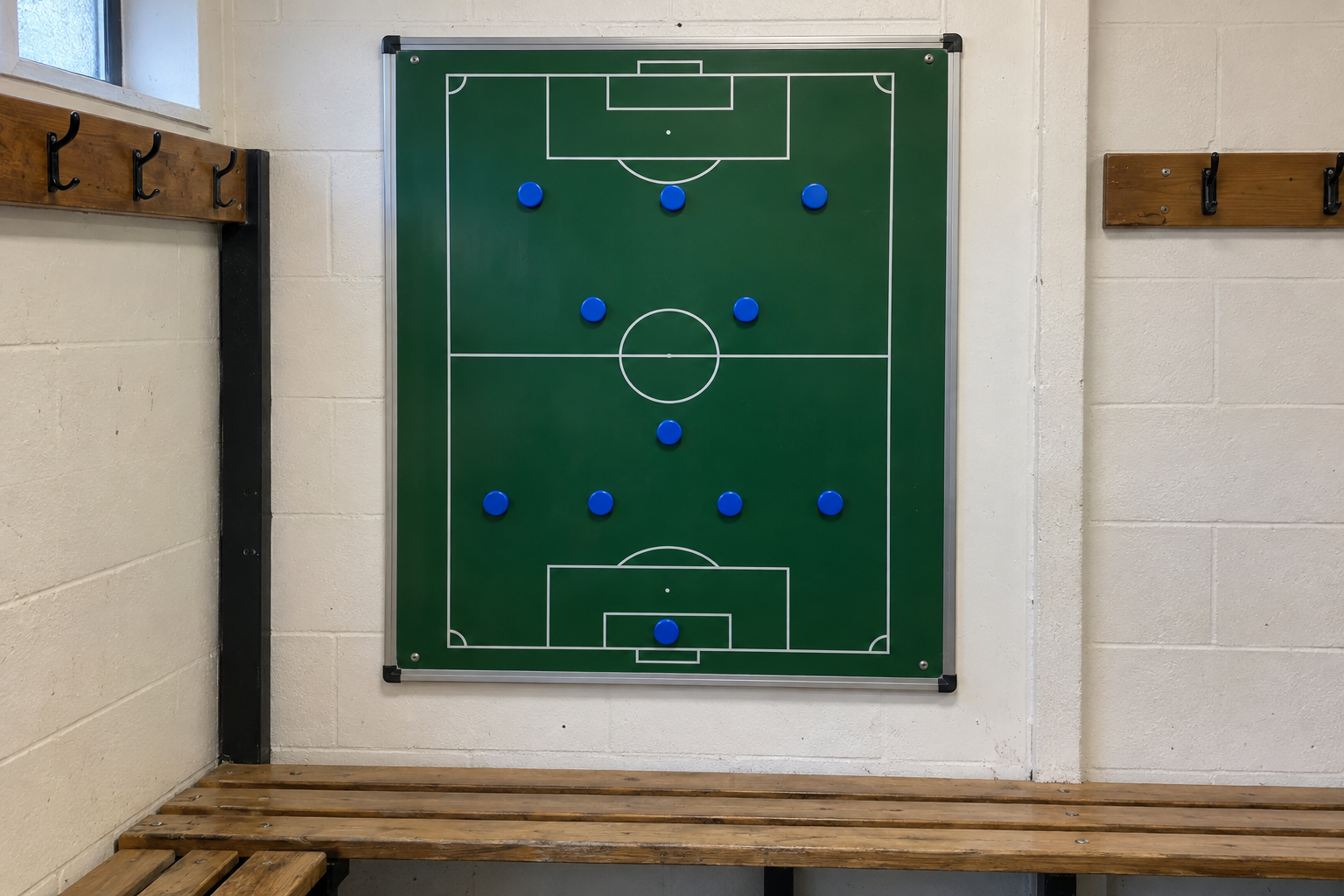
The 4-3-3 is one of the most recognisable and influential formations in modern football. It is frequently associated with possession, high pressing, the use of the full width of the pitch and intelligent occupation of space. However, simply arranging the players as four defenders, three midfielders and three forwards does not guarantee attacking or dominant football.
The true strength of the formation comes from the relationships between the players. The full-backs must coordinate with the wingers, the defensive midfielder must connect the units, the two central midfielders must interpret the available spaces, and the centre-forward must create solutions for both themselves and their teammates.
The 4-3-3 is more than a distribution of players across the pitch. It is a structure that can provide width, depth, numerical superiority in central areas and numerous possibilities for tactical transformation.
The principle is simple:
The formation determines the starting positions, but the players’ movement and relationships define its identity.
The Centre-Backs – The Starting Point of the Build-Up
The two centre-backs form the foundation of the first build-up line. When the goalkeeper has the ball, they move wider to increase the area the opposition must cover and create passing lanes towards the midfielders.
By actively involving the goalkeeper, the team can create a three-versus-two numerical advantage against the opposition’s first pressing line. The objective is not to circulate the ball without purpose, but to attract opponents and find a free player beyond the pressure.
The centre-backs must be able to:
- receive the ball with an open body position;
- recognise which opponent initiates the press;
- carry the ball forward when they are not under pressure;
- find the defensive midfielder;
- play towards the full-backs;
- switch the direction of the build-up;
- pass directly towards a player positioned between the lines;
- recognise the correct moment to play long.
When one centre-back carries the ball forward, they can attract an opposition midfielder. This movement may release one of the central midfielders or open a passing lane towards a winger.
Defensively, the centre-backs control the area in front of goal, track the striker’s movements and protect the space behind the defensive line. Their positioning always depends on the pressure applied to the ball carrier.
If the ball is covered, the defensive line can advance. If the opponent has time and can play forward, the defenders must be prepared to protect the space in behind.
The Full-Backs – Width, Support or Inside Positioning
The full-backs can completely change the shape of the 4-3-3. Their role is not limited to advancing along the touchline and delivering crosses. Their positioning must be adapted to the wingers’ movements, the opposition’s structure and the location of the ball.
A full-back can:
- remain wide to provide an outside passing option;
- overlap the winger;
- occupy an inside channel;
- drop deeper to support the build-up;
- form a back three alongside the centre-backs;
- maintain a covering position behind the attack.
If the winger remains close to the touchline, the full-back can move inside and support the midfield. If the winger moves into the inside channel, the full-back can advance on the outside.
The two full-backs do not always need to perform identical roles. When the right-back advances, the left-back can remain deeper or move inside alongside the centre-backs. This asymmetry allows the team to attack with enough players while maintaining a safety structure behind the ball.
Defensively, the full-backs must control the opposition’s wingers, protect the inside spaces and coordinate the moment when they step out to apply pressure. If they move towards the wide opponent too early, they can leave a dangerous gap between themselves and the nearest centre-back.
The Defensive Midfielder – The Centre of the Formation
The defensive midfielder, often referred to as the number 6, is the balancing point of the 4-3-3. Their positioning influences both the attacking build-up and the team’s protection after possession is lost.
During the build-up, the number 6 must move out of the opponent’s cover shadow and continuously provide a passing option between the centre-backs and the two central midfielders.
The number 6 can:
- receive between the opposition’s first pressing lines;
- drop between the centre-backs;
- move into a deeper position to one side of them;
- play with one touch to escape pressure;
- switch the direction of the attack;
- control the tempo of possession;
- protect the space left behind by advancing midfielders.
Their movement into a deeper position should not be automatic. If they move too close to the centre-backs, the team may lose a passing option in midfield and attract another opponent towards its own goal.
Sometimes, the best decision is to remain higher, pin an opponent and create space for a centre-back to carry the ball forward.
After possession is lost, the number 6 must protect against the opposition’s first vertical pass. They often become the player responsible for delaying the counterattack, winning the second ball or covering the teammate who pressures the ball.
The Central Midfielders – The Connection Between the Units
The two central midfielders, often known as the number 8s, are one of the defining features of the 4-3-3. They must connect the build-up with the attack, occupy spaces between the lines and support the press.
They should not remain on the same horizontal line at all times. Positioning themselves at different heights makes the team more difficult to control and creates more passing angles.
One central midfielder can drop deeper to support the build-up while the other advances between the opposition’s lines. When the ball reaches a wide area, the nearest midfielder can form a triangle with the full-back and winger.
The central midfielders must be able to:
- receive while facing the opposition’s goal;
- move beyond the opposition’s midfield line;
- play with one touch;
- carry the ball to attract an opponent;
- provide an option in the inside channel;
- attack the space vacated by the striker;
- arrive in finishing areas;
- react immediately after possession is lost.
If both central midfielders advance simultaneously without proper support for the number 6, the team can become vulnerable during the defensive transition. Their movements must therefore be coordinated, while the position of the ball should continuously influence the distances between them.
The Midfield Triangle
The defensive midfielder and the two central midfielders form the central triangle of the system.
In its usual shape, the triangle points backwards: the number 6 plays behind the two number 8s. This structure provides the team with a foundation for the build-up and two players who can occupy more advanced positions.
The triangle allows the team to:
- create several passing angles;
- circulate the ball around the pressure;
- occupy different vertical lines;
- create superiority in central areas;
- access players positioned between the lines;
- protect the centre after possession is lost.
However, these positions should not be understood rigidly. The number 6 can advance, one of the central midfielders can drop deeper, and the orientation of the triangle can change during play.
The important factor is that the players avoid standing on the same horizontal line and maintain the connection between the units.
The Wingers – The Main Providers of Width and Unpredictability
In the 4-3-3, the wingers begin in wide positions, but their role is not limited to playing close to the touchline.
They must create width, isolate the opposition’s full-backs and attack the spaces behind the defensive line. At the same time, they can move inside to combine with the striker and midfielders.
A winger can:
- remain wide to stretch the opposition’s block;
- receive to feet and attack in a one-versus-one situation;
- attack the space in behind;
- move into the inside channel;
- combine with the nearest midfielder;
- open the outside channel for the full-back;
- attack the far post when the ball is on the opposite side.
The position of the far-side winger is particularly important. They should not remain passive near the touchline. They can move towards goal to become a finishing option or to control a possible second ball.
Defensively, the wingers must participate in directing the opposition’s build-up. Depending on the team’s tactical plan, they can press the full-backs or block the passing lanes towards them.
The Centre-Forward – The Attacking Reference Point
The striker in a 4-3-3 must provide depth, pin the centre-backs and create space for teammates. They are the team’s main attacking reference point but should not remain isolated between the two opposing centre-backs.
The striker can drop deeper to receive between the lines. When this happens, a central midfielder or winger must attack the space created behind the defensive line.
The striker can also:
- pin both centre-backs;
- lay the ball off to players arriving from deeper positions;
- attack the near post;
- move into wide areas;
- protect the ball with their back to goal;
- participate in quick combinations;
- initiate the press.
Defensively, the striker must direct the opposition’s build-up. The angle of their run can block the pass between the centre-backs or deny access to the defensive midfielder.
Pressing does not begin with a random run. It begins with a movement that removes one of the opponent’s options.
Creating Overloads in Wide Areas
One of the main strengths of the 4-3-3 is the possibility of forming natural triangles on both sides of the pitch.
On the right side, the triangle can be formed by:
- the right-back;
- the right central midfielder;
- the right winger.
The same relationship appears on the left side.
These triangles provide the ball carrier with several options and allow the team to:
- combine with one or two touches;
- create two-versus-one situations;
- attract opponents;
- progress through the third player;
- release the inside or outside channel;
- rotate positions quickly.
If the winger moves inside, the full-back can advance on the outside. If the full-back remains deeper, the winger can maintain the width while the central midfielder attacks the space between the opposition’s full-back and centre-back.
The effectiveness of these relationships depends not only on the positions occupied but also on the timing of the players’ movements.
How the Formation Transforms in Possession
During the attacking phase, the 4-3-3 frequently changes its structure. The initial formation can become a 2-3-5, 3-2-5 or 3-1-6, depending on the positions of the full-backs and midfielders.
In a 2-3-5 structure, the two centre-backs form the first line. The two full-backs and defensive midfielder can position themselves ahead of them. The attacking line of five can then be occupied by the wingers, central midfielders and striker.
In a 3-2-5 structure, one full-back can remain alongside the centre-backs while the other advances. Two midfielders stay in front of the back three to control circulation and defensive transitions.
These transformations are designed to:
- occupy all five vertical channels;
- create width and depth;
- position players between the lines;
- support the ball carrier;
- maintain a safety structure behind the attack;
- prepare the reaction after possession is lost.
The team should not attempt to occupy every space with as many players as possible. It must occupy the right spaces while maintaining distances that support circulation and collective movement.
Defensive Organisation
Without the ball, the 4-3-3 can transform into a 4-1-4-1. The wingers drop alongside the central midfielders, while the number 6 protects the space in front of the centre-backs.
This structure allows the team to form two compact lines and protect the central area.
In a mid-block, the striker can direct the opposition’s build-up towards one side. The nearest winger prepares to press the full-back, the central midfielder closes the inside option, and the remaining players shift towards the side of the ball.
When the team presses high:
- the striker directs the centre-backs;
- the nearest winger pressures the full-back;
- the central midfielder steps forward towards the opposing midfielder;
- the far-side winger moves inside;
- the number 6 protects the space behind the first press;
- the defensive line advances to maintain compactness.
If the lines behind the press do not move forward, the pressure becomes a series of individual runs and leaves large spaces between the units.
The Attacking Transition
After regaining possession, the 4-3-3 provides clear options in both width and depth.
The first look should be forward. The wingers can immediately attack wide or diagonal spaces, the striker can pin the centre-backs, and the central midfielders can support the attack from deeper positions.
If rapid progression is unavailable, the team must secure possession and restore its attacking structure.
The player who wins the ball needs:
- a nearby safety option;
- a player between the lines;
- a run in behind;
- width on the opposite side;
- support behind the ball.
The transition depends not only on the first pass but also on the reactions of the players without the ball.
The Defensive Transition
The 4-3-3 can become vulnerable after possession is lost, particularly when both full-backs and the two central midfielders are positioned high up the pitch.
For this reason, the team must prepare its defence while attacking. A structure must be maintained behind the ball to control the opposition’s forwards and block vertical passes.
After possession is lost, the nearest player applies pressure while the others:
- close the nearby passing options;
- protect the central area;
- control the opponents who have remained forward;
- prepare for the duel following a long pass;
- reduce the distances between the units.
If enough players are positioned around the ball, the team can attempt to regain possession immediately. If the opposition escapes the first pressure, the players must stop chasing individually and restore the defensive block.
The Advantages of the 4-3-3
The formation offers a natural distribution across the entire pitch and creates numerous relationships between players.
Its main advantages include:
- effective occupation of the width;
- a constant presence in central areas;
- natural passing triangles;
- the possibility of creating wide overloads;
- two wingers prepared for individual duels;
- three players in the first pressing line;
- flexibility when transforming the structure;
- access to spaces between the opposition’s lines;
- favourable conditions for regaining possession quickly after losing it.
The formation allows the team to control the ball without sacrificing depth and to apply pressure without completely losing its balance.
The Vulnerabilities of the 4-3-3
Although it is a well-balanced formation, the 4-3-3 can encounter problems if the distances and relationships between players are not correct.
Its most common vulnerabilities include:
- isolation of the centre-forward;
- large spaces around the defensive midfielder;
- both full-backs advancing simultaneously;
- a lack of defensive reaction from the wingers;
- spaces between the full-backs and centre-backs;
- the central midfielders positioning themselves too high;
- difficulties against teams using two strikers;
- exposure of the wide areas during defensive transitions;
- a lack of presence inside the penalty area when the wingers remain too wide.
The number 6 can become isolated if the two central midfielders do not react quickly enough. Similarly, the striker can be left alone if the wingers do not move towards goal and the midfielders fail to support the attack.
Beyond the Numbers
Not every team that starts in a 4-3-3 plays in the same way. Some teams use very wide wingers and inverted full-backs. Others allow the full-backs to provide width while the wingers become inside forwards.
Some teams build through possession and short passes. Others use the same structure for high pressing and quick vertical attacks.
The team’s identity is influenced by:
- the characteristics of the players;
- the role of the defensive midfielder;
- the freedom given to the two central midfielders;
- the positioning of the full-backs;
- the behaviour of the wingers;
- the profile of the striker;
- the principles established by the coach.
The numbers show us where the players begin. The principles show us what they are trying to achieve.
Conclusion
The 4-3-3 provides the team with a balanced, flexible structure designed to control space. It creates natural triangles, allows the team to occupy the full width of the pitch and offers solutions for build-up, progression, pressing and transitions.
However, its effectiveness does not automatically come from the players’ starting positions. The full-backs must coordinate with the wingers, the defensive midfielder must maintain balance, the central midfielders must interpret the available spaces, and the striker must connect and finish attacks.
The message should be clear:
In the 4-3-3, every position is connected to the others. When one player moves, a teammate must occupy the space they leave behind.
The true anatomy of the formation is not visible when the players are positioned on a tactics board. It can be seen in the way the team transforms, maintains its connections and reacts collectively to every change in the game.