In youth football development, one of the biggest illusions is believing that players make good decisions because they are constantly told what to do.
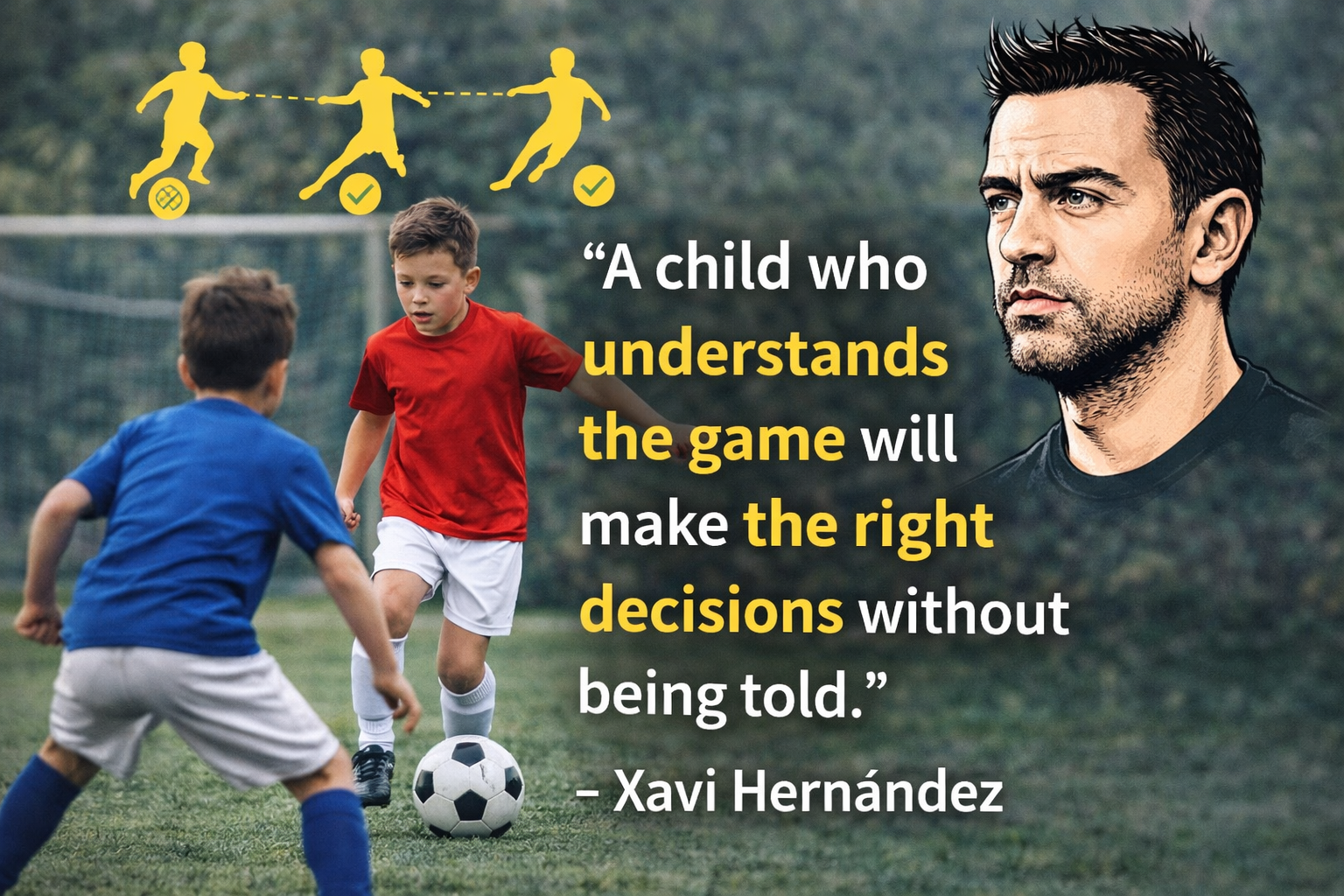
Xavi Hernández, one of the most intelligent players in football history, delivers a fundamental lesson: good decisions don’t come from constant instructions, but from understanding the game.
A child who understands the game doesn’t wait for commands.
He reads the situation and acts.
Why we shouldn’t tell children everything
When a coach gives instructions in every moment:
-
players stop observing the game on their own;
-
they react to the coach’s voice, not to the situation;
-
they look for the “correct” answer instead of the best solution.
Over time, players become dependent on instructions and lose autonomy.
Game understanding is replaced by mechanical execution.
Game understanding equals decision-making ability
A child who understands the game:
-
scans before receiving the ball;
-
anticipates opponents’ movements;
-
recognizes free space;
-
adapts decisions to the context.
These abilities are not built through long explanations, but through repeated experience in real game situations.
Xavi didn’t become a great player because he ran more or received perfect instructions.
He became great because he understood the game faster than everyone else.
From executors to thinkers
The goal of a development-focused coach is not to create players who:
-
blindly follow instructions;
-
play “safe” out of fear;
-
avoid initiative.
But players who:
-
take responsibility for decisions;
-
make mistakes and learn from them;
-
think independently;
-
adapt to changing situations.
A child who understands the game will make the right decision even when the coach is silent.
What coaches can do in practice
To develop real game understanding:
-
talk less and observe more;
-
use questions (“What did you see?”);
-
design exercises with multiple solutions;
-
allow players to decide — even if they make mistakes.
Very often, silence is the best teaching tool.
Conclusion
Xavi Hernández’s quote is a clear reference point for youth football:
if we want intelligent players, we must help them understand the game, not memorize instructions.
A child who understands the game doesn’t need to be guided step by step.
He will make the right decisions on his own — exactly when it matters most.