
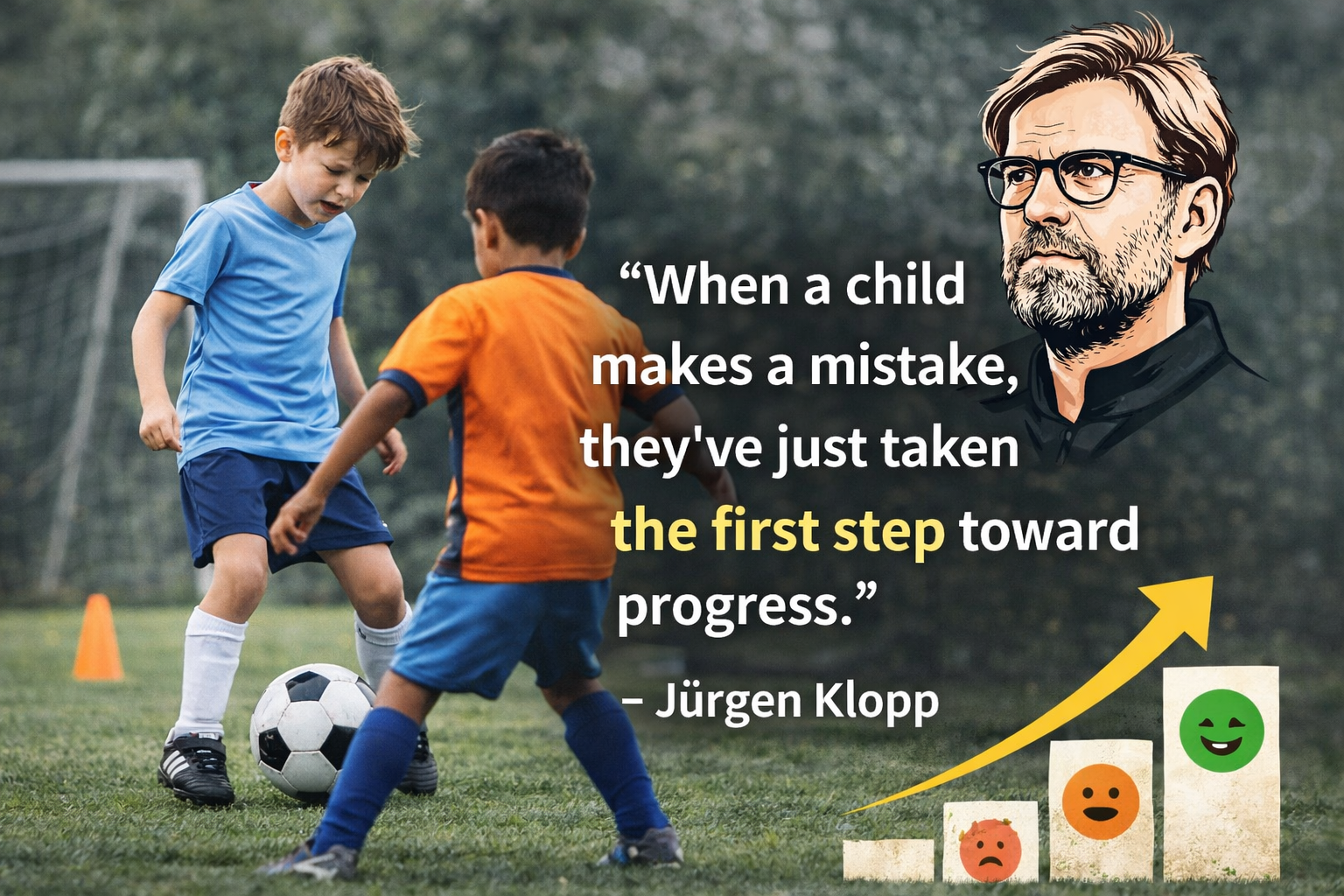
In youth football, mistakes are often seen as obstacles. Something that must be corrected quickly, avoided, or even punished.
Jürgen Klopp invites us to see mistakes from a completely different perspective: not as failure, but as the beginning of progress.
A child who makes a mistake is not taking a step backward.
On the contrary — they are taking their first step forward.
Mistakes are proof of involvement
A child who rarely makes mistakes is often a child who:
-
plays cautiously;
-
avoids risk;
-
chooses the safe option instead of the creative one;
-
fears the reaction of adults.
On the other hand, a child who makes mistakes:
-
tries new things;
-
makes decisions;
-
steps out of their comfort zone;
-
is actively involved in the game.
Mistakes only appear where there is courage.
Why progress always starts with a mistake
Every real learning process includes:
-
trying;
-
failing;
-
adjusting;
-
repeating.
Without mistakes, there is nothing to correct.
Without correction, there is no progress.
Klopp highlights this fundamental truth: progress doesn’t begin when a child does everything perfectly, but when they dare to try.
The coach’s role when mistakes happen
The difference between a child who develops and one who stagnates is often the adult’s reaction:
-
shouting can block learning;
-
punishment can inhibit creativity;
-
labeling can cause long-term damage.
Instead:
-
encouragement builds safety;
-
questions stimulate thinking;
-
patience builds confidence.
A coach’s role is not to eliminate mistakes, but to create an environment where mistakes can be used.
Mistakes as an educational tool
In a healthy development environment, mistakes become:
-
feedback;
-
learning opportunities;
-
sources of adaptation;
-
a natural step in development.
Children who know they can make mistakes without being judged will have the courage to:
-
think independently;
-
create;
-
take responsibility for their decisions.

Conclusion
Jürgen Klopp’s quote delivers a powerful message to every coach and parent:
a mistake is not the end of the journey, but the beginning of it.
A child who makes mistakes learns.
A child who is allowed to make mistakes… progresses.
If we want brave, intelligent, and creative players, we must stop seeing mistakes as a problem and start seeing them as the first proof of progress.