
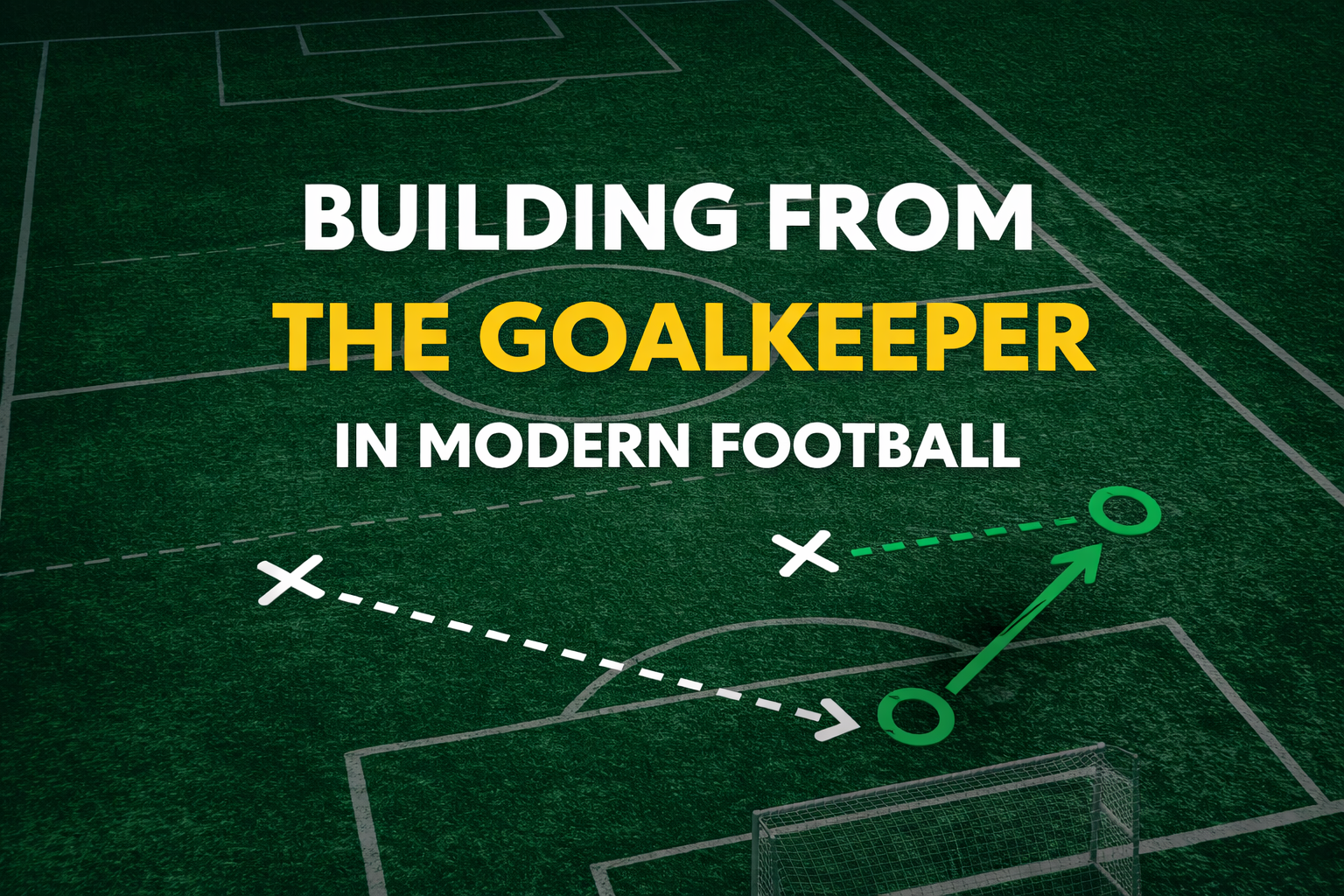
In modern football, building from the goalkeeper is no longer just a way to restart play — it is the foundation of the entire attacking phase.
In many contemporary systems, the goalkeeper becomes the first playmaker, and the team establishes its attacking structure from its own defensive third.
A well-executed build-up provides calm, control, progression, and allows the team to break opposition pressing lines through intelligence, not through random long balls.
This article presents the key principles for building effectively from the goalkeeper, regardless of the system of play.
1. The Goalkeeper – The First Playmaker
In the modern game, the goalkeeper is not just a short-pass executor. He must be:
- calm under pressure,
- capable of offering diagonal passing options,
- constantly connected with centre-backs and supporting midfielders,
- involved in creating numerical superiority (11v10).
Key principle:
The goalkeeper becomes a third defender in the build-up, not an isolated player in goal.
A slightly advanced position allows him to attract pressure and create useful spaces for progression.
2. Positioning of Centre-Backs and Full-Backs
An effective build-up starts with the structure of the defensive line. There are three common variations:
a) Centre-backs split wide (classic “U-shape”)
– creates clear passing lanes;
– stretches the opponent;
– encourages central progression.
b) One centre-back stays central, the other moves wider
– used in systems with offensive full-backs;
– creates better vertical passing angles.
c) Full-back drops into the defensive line (“back three in build-up”)
– creates a 3v2 or 3v1 advantage in the first line;
– allows the opposite full-back to push higher.
Main principle:
The defensive line must always create a free player.
3. The Holding Midfielder – The Key to Progression
The number 6 plays a decisive role in opening the game:
- positions between centre-backs or between opposition lines,
- provides the first vertical option,
- buys time through oriented control.
Two essential behaviours:
• Finding free spaces (“checking in”)
The midfielder arrives at an angle, never on the same line as the defenders.
• Attracting pressure
When the pivot attracts an opponent, another player becomes free — enabling progression.
4. Creating Passing Triangles
Modern build-up relies on triangles and diamonds, which allow:
- multiple options for the player on the ball,
- continuity in circulation,
- avoidance of isolation under pressure.
A good triangle includes:
- the ball carrier,
- a short support option,
- a vertical option.
If one is missing, the opponent’s press becomes dangerous.
5. Attracting and Beating the Press
Building from the back is pointless if the team does not understand why it does it.
The main objective:
to attract pressure in one area and progress in another.
Effective methods:
- centre-back fixes the opponent and plays diagonally;
- pivot attracts 1–2 players and frees the wide area;
- back pass to the goalkeeper forces the opponent to step higher, creating space ahead.
Golden rule:
Attract – Fix – Release – Progress.
6. Mobility of Full-Backs and Midfielders
In build-up, full-backs can have three roles:
- wide and high – to create space inside;
- inverted – to create central superiority;
- in line with centre-backs – to form a back three.
Midfielders must synchronize with them:
- if the full-back goes high → the midfielder covers;
- if the full-back moves inside → the midfielder rotates wide.
Without mobility, the build-up becomes predictable and easy to stop.
7. Timing the Switch of Play
A successful build-up requires:
- patience,
- tempo variation,
- switching play at the right moment.
Switching the ball helps break compact defensive blocks, especially against teams pressing aggressively on one side.
8. Common Mistakes in Build-Up
- centre-backs positioned too close;
- pivot receiving with back under pressure;
- goalkeeper passing without fixing the opponent first;
- only short play, without a long option → predictable;
- lack of synchronized movements.
Conclusion
Modern build-up from the goalkeeper is a complex but highly effective process in developing an organized attacking game. It is not just about short passes, but about:
- structure,
- superiority,
- attracting pressure,
- intelligent progression.
When a team understands these principles, build-up becomes a true weapon.