A team should not begin defending only after losing the ball. Its defensive organisation must be prepared during the attack through the positioning of the players who are not directly involved in the build-up or finishing phase.
In modern football, attacking and defending are not completely separate phases. The way a team occupies the pitch in possession determines how vulnerable it will be when the ball is lost.
The principle is simple:
While some players build the attack, others must protect the team’s balance.
What Does Defensive Preparation During an Attack Mean?
Defensive preparation, also known as rest defence, refers to the structure maintained behind the ball to control a potential counterattack.
This structure should allow the team to:
- react immediately after losing possession;
- protect the central area;
- control opponents who remain in advanced positions;
- close vertical passing lanes;
- win the second ball;
- delay the opposition’s counterattack.
The objective is not for several players to remain passive in defence. They should occupy positions from which they can support the attack while simultaneously protecting the team.
Maintaining a structure behind the ball
The number of players who remain behind the ball depends on the position of the attack, the level of risk and the number of opponents staying forward.
The team can use structures such as:
- three players in the first line with two positioned in front;
- two centre-backs and one defensive midfielder;
- three defenders and one central midfielder;
- a more cautious back four in high-risk situations.
There is no single structure suitable for every team. The important factor is that the players remaining behind the action can simultaneously control the ball, the opponents and the dangerous spaces.
Protecting the central area
The centre of the pitch must be the first priority. After regaining possession, the opposition will often try to play vertically towards a striker or a midfielder positioned between the lines.
The players responsible for defensive balance should position themselves to:
- block the first forward pass;
- protect the space in front of the centre-backs;
- prevent the striker from turning;
- guide the opposition’s transition towards the outside;
- provide cover for the teammate attacking the ball.
The team may sometimes allow the opposition to play wide if it prevents them from progressing directly towards goal.
Positioning in Relation to Opponents Remaining Forward
The defenders should not focus exclusively on the ball. They must constantly control the attackers whom the opposition keeps in advanced positions.
Their positioning should allow them to see both the ball and their direct opponent. They need to be close enough to anticipate the pass while maintaining enough distance to protect the space in behind.
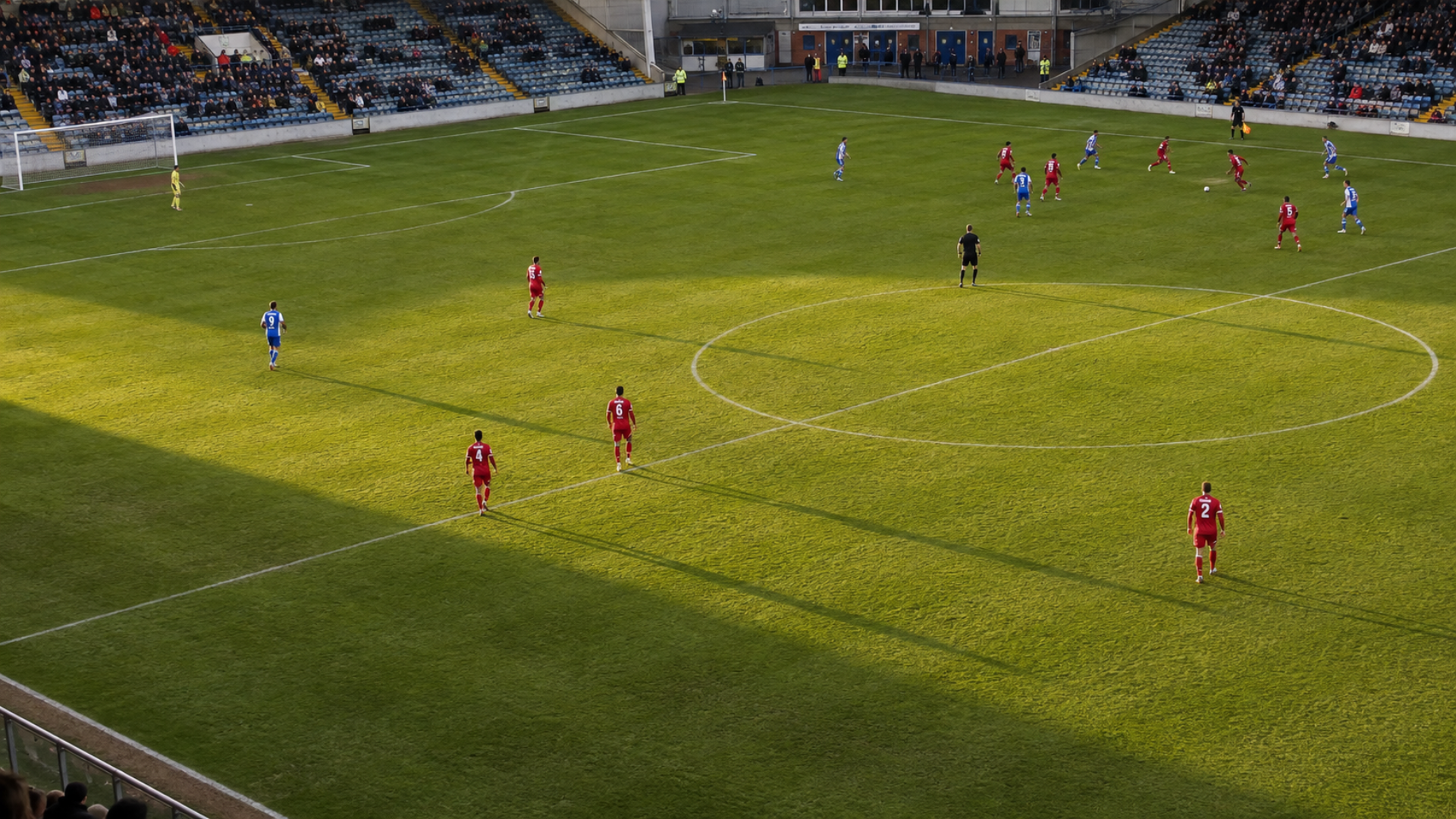
If the opposition leaves two attackers forward, the team in possession can keep three players behind the ball to create a safety overload.
The principle can be expressed simply:
Keep at least one more player behind the ball than the number of opponents prepared to counterattack.
Balance on the opposite side
When the attack develops in a wide area, the players on the opposite side should not remain fixed to the touchline without a clear purpose.
The far-side full-back can move inside to:
- protect the space in front of the centre-backs;
- control an opponent positioned centrally;
- prepare for a possible switch of play;
- create an overload after possession is lost;
- reduce the distances between the players remaining behind the action.
This inside position provides greater stability without completely removing the possibility of continuing the attack on the opposite side.
Distances between players
The defensive structure will not be effective if the players are too far apart. The distances must allow quick intervention and mutual cover.
If one player pressures the ball after possession is lost, the others must be able to:
- close the passing options;
- provide cover;
- intercept the vertical pass;
- protect the space behind the pressure.
A team that remains compact while attacking can react more quickly during the defensive transition.
Preparing for Where the Ball May Be Lost
The risk of losing possession is not the same in every situation. A safe sideways pass does not create the same danger as a cross, dribble or difficult vertical pass.
Before a high-risk action, the players must adjust their positions.
For example, when the winger prepares to cross:
- the centre-backs control the opposition’s attackers;
- the defensive midfielder protects the central area;
- the far-side full-back moves inside;
- the players around the penalty area prepare for a clearance;
- the team controls the space from which the counterattack may begin.
The organisation must be prepared before possession is lost—not after the opposition has already regained the ball.
The immediate reaction after losing possession
A good structure allows the team to quickly choose between two solutions:
- immediate pressing, when enough players are positioned close to the ball;
- defensive reorganisation, when the opposition has escaped the first area of pressure.
The nearest player pressures the ball carrier, the others close the available options, and those behind the ball protect the centre and the space in behind.
If an immediate recovery is not possible, the team must delay the opponent’s attack and restore its defensive block.
Common mistakes
The most common problems include:
- too many players positioned ahead of the ball;
- both full-backs advancing simultaneously without cover;
- the defensive midfielder moving too close to the opposition’s penalty area;
- defenders following the ball and losing track of the attackers;
- excessive distances between the covering players;
- the far side remaining too wide;
- reacting only after possession has been lost;
- failing to prepare for a clearance or second ball.
A team can attack well and still remain vulnerable if it does not maintain balance behind the action.
How can we train this behaviour?
Defensive preparation should be integrated into attacking exercises rather than trained separately from the game.
During positional games or finishing exercises, the coach can observe:
- the number of players remaining behind the ball;
- protection of the central area;
- control of the opposition’s attackers;
- the position of the far-side full-back;
- the reaction after losing possession;
- the ability to win the second ball;
- the decision between immediate pressing and recovery.
The players must understand that their defensive responsibility does not disappear when the team attacks.
Conclusion
A balanced team begins defending before it loses the ball. Through the correct positioning of the players behind the action, it can support the attack while simultaneously controlling the possibility of a counterattack.
The message to the players should be clear:
We attack with enough players to create danger, but we maintain a structure that allows us to react immediately if we lose the ball.
A well-organised attack does not focus only on approaching the opposition’s goal. It also prepares how the team will defend in the next second.