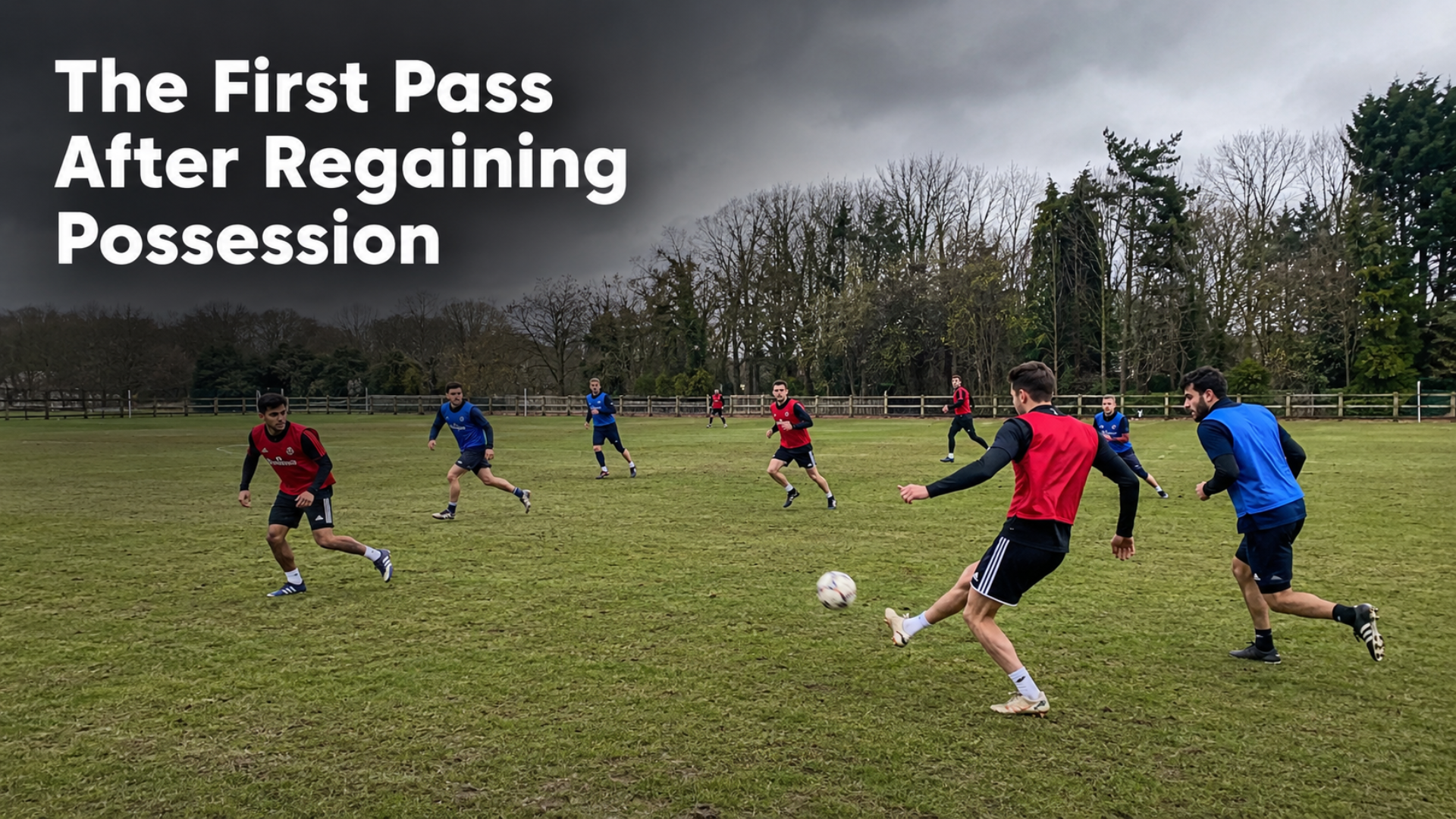
Regaining the ball does not automatically mean that the team has gained control of the situation. The first moments after recovery are decisive because the opposition is still disorganised, but the players who have won the ball may also be under immediate pressure.
The first pass can transform the recovery into a dangerous attack—or cause the team to lose possession again immediately.
The principle is simple:
It is not enough to regain the ball. We must know what to do with it immediately afterwards.
The first look should be forward
After winning possession, the player should first assess the possibility of progressing. The opposition is in transition, the distances within its defensive structure may be large, and certain spaces become temporarily available.
The first pass can be played:
-
forward to a player positioned between the lines;
-
in behind the defensive line;
-
towards a wide area that has been left open;
-
to a teammate who can continue the attack while facing the goal.
Looking forward does not mean forcing every vertical pass. It means quickly identifying whether a genuine opportunity to progress exists.
When should we secure possession?
Not every recovery should be followed by a counterattack. If the player who wins the ball is surrounded, has no clear option or the team is unbalanced, the first pass should secure possession.
A sideways or backward pass may allow the team to:
-
escape the opponent’s immediate pressure;
-
restore its positions;
-
control the tempo;
-
avoid another defensive transition;
-
prepare an organised attack.
The correct decision is not always the most attacking one. It is the decision that preserves the advantage created by regaining the ball.
The location of the recovery influences the decision
The area in which possession is regained changes the objective of the first pass.
Near the opposition’s goal, the first option should be rapid progression or an attempt to finish because the opponent is vulnerable and the goal is close.
In the middle third, the player must assess whether a counterattack can be activated or whether retaining possession is the safer option.
Near the team’s own goal, the priority is to escape the danger area. A risky pass through the centre may give the opposition another goalscoring opportunity.
The first pass must be adapted to the available space, the pressure and the positions of teammates.
Preparing for the Recovery Before Winning the Ball
The quality of the first pass depends on the information collected before the recovery. Before gaining possession, the player should observe the positions of opponents, teammates and the available spaces.
Scanning allows the player to recognise:
-
where the free teammate is;
-
the direction from which pressure is coming;
-
whether a forward pass is available;
-
whether there is space to carry the ball;
-
where the safe option is positioned.
A player who scans before regaining possession can act more quickly and exploit the opponent’s disorganisation.
The role of teammates without the ball
The player who wins possession cannot create the transition alone. Teammates must immediately provide different passing options.
After the recovery:
-
one player moves closer to offer a safe passing option;
-
other players attack the available spaces;
-
one teammate occupies the central area;
-
the wide players provide width;
-
the players behind the ball maintain defensive balance.
The first pass becomes effective when the entire team reacts to the recovery—not only the player who wins the ball.
Passing Speed and Body Orientation
The first pass must have the correct speed and be played towards the foot that facilitates the receiver’s next action.
A slow pass gives the opposition time to reorganise. A pass that is too powerful may make control difficult and interrupt the team’s progression.
Playing towards the foot furthest from the pressure can also help the teammate receive with an open body position and continue the attack more quickly.
The technical quality of the execution directly influences the tactical value of the recovery.
Common mistakes
The most common problems include:
-
forcing a vertical pass immediately after regaining possession;
-
failing to scan before receiving the ball;
-
carrying the ball for too long;
-
playing a slow pass that allows the opposition to react;
-
teammates remaining static;
-
ignoring the safe passing option;
-
losing possession immediately in a dangerous central area.
The desire to attack quickly should not be confused with rushing. The speed of play is determined by the quality of the decision, not only by the speed of execution.
How Can We Train the First Pass After Recovery?
This behaviour can be developed through small-sided games and transition exercises in which the team receives an immediate objective after winning possession.
The coach can reward:
-
a vertical pass towards a free player;
-
moving the ball away from the recovery area;
-
a quick switch of play;
-
finishing within a short period;
-
retaining possession when progression is unavailable.
The exercises should require players to choose between attacking quickly and securing the ball—not automatically repeat the same solution.
Conclusion
The first pass after regaining possession determines the direction of the attacking transition. It can activate a counterattack, eliminate an opposition line or give the team time to organise its attack.
The message to the players should be clear:
After regaining possession, look forward first. If we can progress, we attack. If we cannot, we retain the ball and prepare the next action.
A recovery becomes truly valuable only when the first decision preserves or increases the team’s advantage.