In youth football development, one of the biggest mistakes is over-protecting players: too many instructions, too many stoppages, and too few moments where children are allowed to decide for themselves.
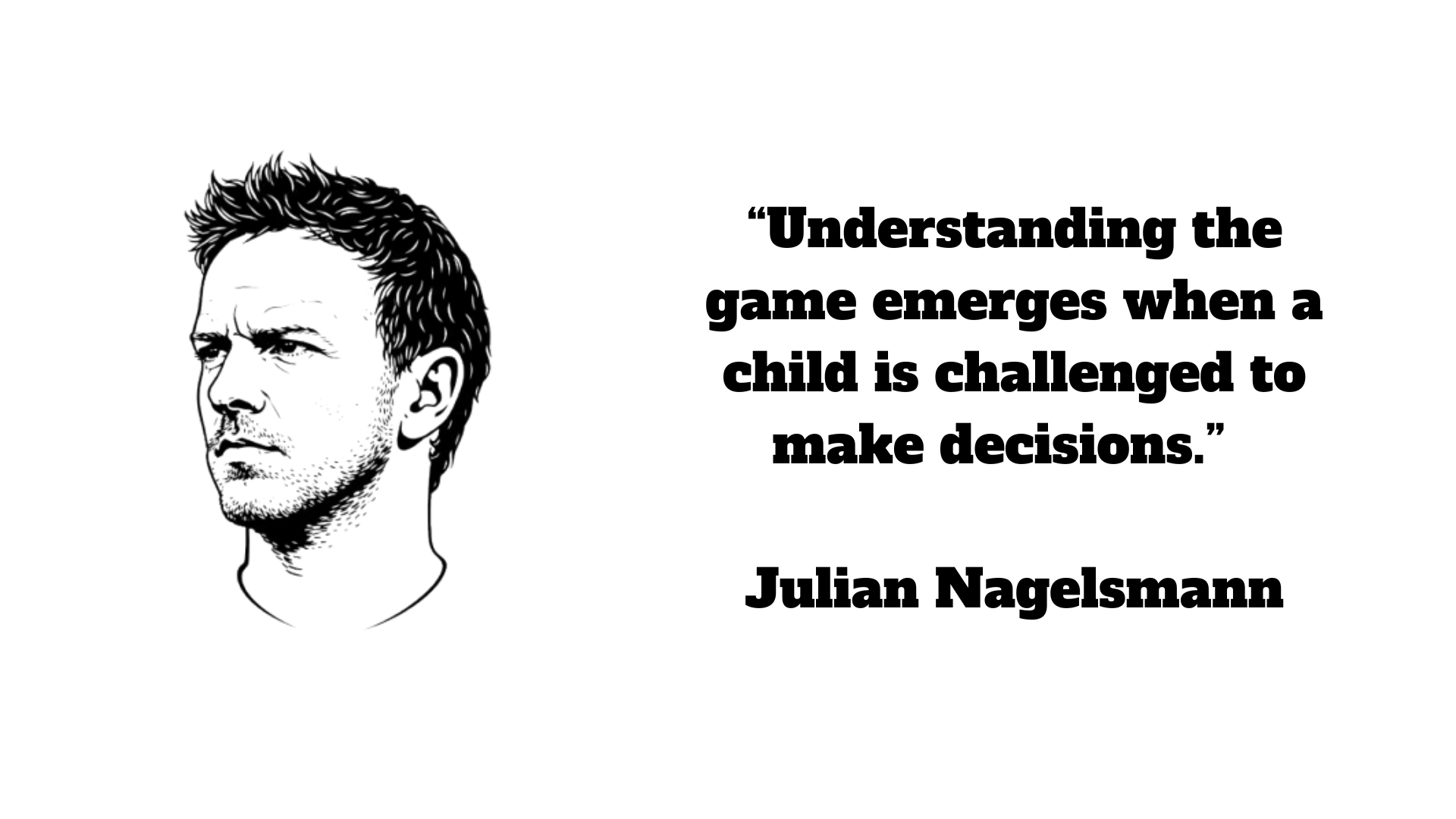
Julian Nagelsmann captures the essence of modern football: game understanding emerges when children are challenged to make decisions.
A child does not understand the game because it was explained to him.
He understands it because he was challenged.
Why decision-making is the key to learning
Every second of the game, a child must choose:
-
pass or dribble?
-
continue forward or change direction?
-
take a risk or play safe?
Without choices, there is no thinking.
Without thinking, there is no understanding of the game.
A training session without decisions is a session without cognitive development.
What happens when children are not challenged
When a coach:
-
gives solutions before players can think;
-
corrects every mistake immediately;
-
constantly stops the game,
children learn to wait for instructions, not to read the game.
Over time, this creates players who are:
-
rigid;
-
dependent on the coach’s voice;
-
unable to adapt to new situations.

Challenge builds game intelligence
Nagelsmann is known for training sessions built around:
-
real game situations;
-
variable-based exercises;
-
changing spaces and rules.
These contexts develop:
-
anticipation;
-
scanning;
-
decision-making speed;
-
adaptability.
A child who is constantly faced with decisions becomes a child who understands the game.
The coach’s role: problem designer
The modern coach is not the one who provides all the answers.
He is the one who creates the right problems for the player’s age and level.
In practice:
-
small-sided games with real opposition;
-
exercises with multiple solutions;
-
simple rules that force decisions;
-
time to make mistakes and reflect.
The key question is no longer “What should I do?” but “What did you see?”
Conclusion
Julian Nagelsmann’s quote defines the direction of modern football education:
children learn the game when they are challenged to think and decide.
If we want intelligent, adaptable, and creative players, we must accept the controlled chaos of decision-making.
Because inside that chaos, real game understanding is born.