
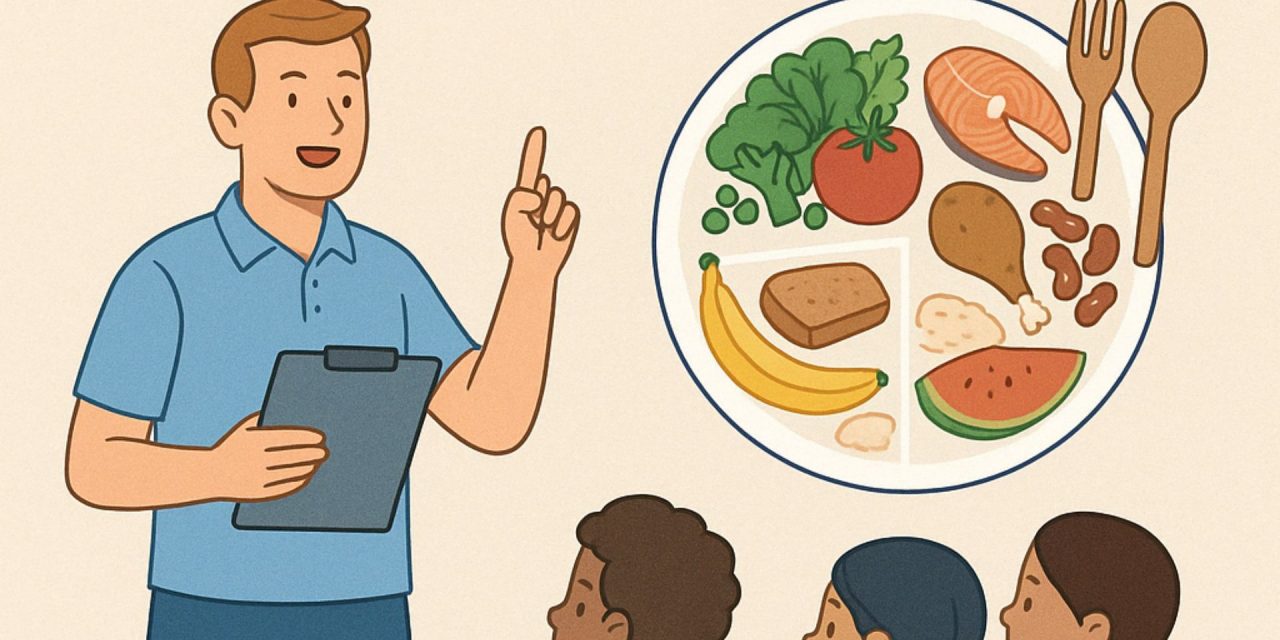
Movement is only one part of a healthy lifestyle.
The other half? Nutrition.
And school is the perfect place to plant these healthy ideas in students’ minds.
The physical education teacher plays a key role in this process, as they are already seen by students—and even by school staff—as a model of an active, healthy lifestyle.
Why is it important to talk about nutrition during physical education lessons?
– Students begin to form their eating habits in school, and they can influence each other’s behavior when it comes to food choices.
– They can make a direct connection between what they eat and how they feel or perform physically.
– Nutritional education helps prevent obesity, fatigue, and other health issues.
How can we integrate nutrition into physical education and sport lessons?
1. Short, natural discussions
There’s no need for long, theoretical lessons that lose students’ attention. Sometimes, a 3–5 minute conversation can make a real difference.
✔ After effort: “What foods do you think help the body recover?”
✔ Before exercises: “What did you eat this morning? Did you feel full of energy?”
✔ During breaks: “Did you know that water helps you focus and is better than sugary drinks?”
These questions should be asked to the whole class, so that both the students’ answers and the teacher’s feedback are heard by everyone.
2. Practical examples related to sports
✔ What does a football player eat before a match?
✔ What healthy snacks could an active student have between classes?
✔ What does a balanced plate look like for a child who exercises regularly?
3. Interactive projects and games
Get students involved in activities related to nutrition:
✔ A “Healthy Menu Challenge” for a day full of movement (perfect for “Green Week”).
✔ Games like “Guess the Healthy Food” or “Myth or Fact about Food.”
✔ Creating a collage of healthy foods using magazine cutouts.

4. Collaboration with other teachers
Work together with biology teachers or class advisors for interdisciplinary topics.
✔ Joint lessons about the digestive system and nutrition.
✔ A Health Week featuring workshops, challenges, and interactive discussions.
5. Be a role model
This might be the most important point of all. If we, as teachers, stand in front of our students with a bottle of cola and a hamburger, it’s hard to send a convincing message about the importance of nutrition.
Students notice the teacher’s behavior:
✔ If you choose a bottle of water instead of soda — they notice.
✔ If you talk about how you plan your meals — they listen.
✔ If you mention that you made fresh orange juice in the morning — they might try it too.
In conclusion:
Nutrition doesn’t need to be a heavy, theoretical lesson — it can be a natural conversation between teacher and students, integrated into the context of sport.
Through small, consistent steps, we can show students that what they put on their plate matters just as much as the movement they do.
👉 Be the teacher who not only talks about sport, but also shows students how to take care of their bodies every day. Start with your next lesson!