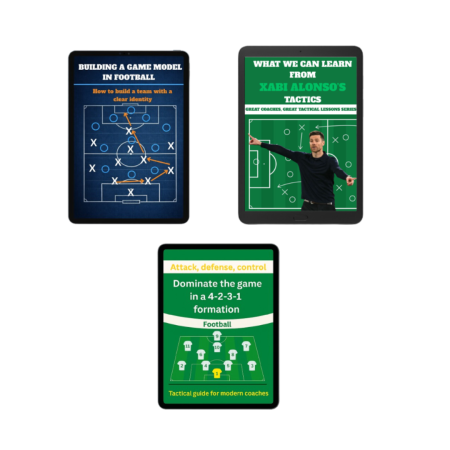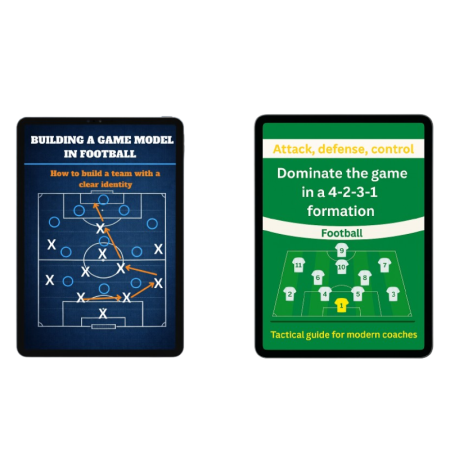
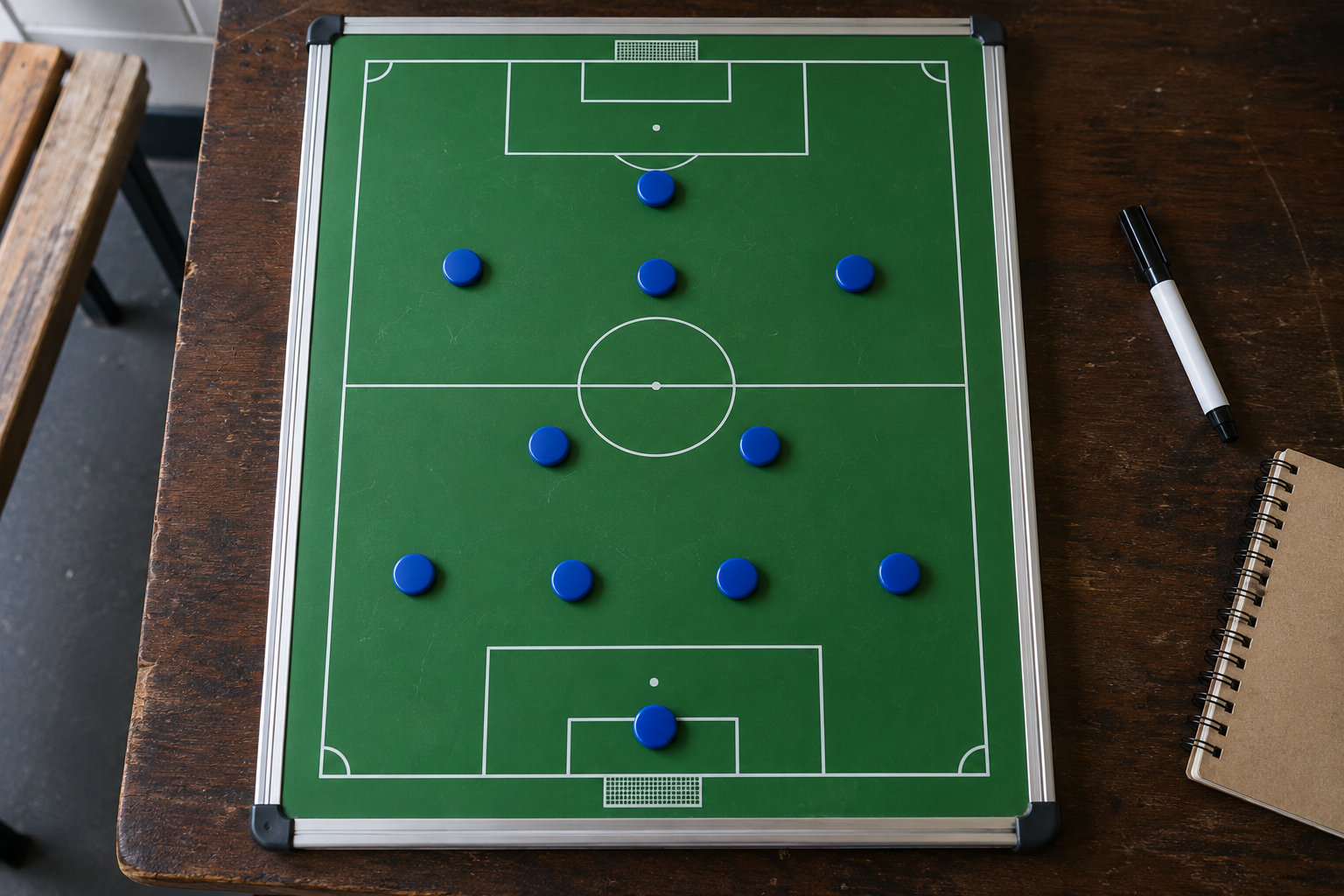
The 4-2-3-1 is one of the most widely used formations in modern football. At first glance, it appears simple to understand: four defenders, two central midfielders, three attacking midfielders and one striker. In reality, its effectiveness is not determined by the positions drawn on the tactics board, but by the relationships created between the players.
The same formation can produce an attacking team capable of dominating through possession or a cautious team organised to defend and counterattack. The difference lies in the players’ roles, the positioning of the full-backs, the behaviour of the two central midfielders and the freedom given to the number 10.
The formation provides the starting positions. The game begins when the players start moving.
The Centre-Backs – The Foundation of the Build-Up
The two centre-backs form the foundation of the structure. During the build-up, they move wider to increase the area the opposition must cover and create passing lanes towards the central midfielders.
When the goalkeeper is actively involved, the first line can create a three-versus-two numerical advantage against the opposition’s first pressing line. The goalkeeper therefore becomes a genuine part of the build-up rather than simply a safety option.
If the centre-backs receive without pressure, they must be prepared to carry the ball forward. By doing so, they can attract an opponent, free a midfielder and create a new passing lane.
Defensively, the centre-backs must control the area in front of goal, protect the space in behind and maintain suitable distances from the full-backs. Their relationship with the two central midfielders is essential for protecting the centre.
The Full-Backs – The Main Providers of Width
In the 4-2-3-1, the full-backs have a major influence on the team’s identity. They can advance to provide width, support the wingers or move inside to create a numerical advantage in central areas.
If the winger moves between the lines, the full-back can advance on the outside. If the winger stays wide, the full-back can occupy an inside channel or maintain a more cautious position.
Both full-backs do not need to advance simultaneously. When the right-back participates actively in the attack, the left-back can remain deeper or move inside. This asymmetry helps the team maintain balance and control a potential counterattack.
Their role is not simply to run along the touchline. They must read the positions of the winger, the midfielders and the opponents before deciding where to position themselves.
The Two Central Midfielders – The Centre of Balance
The two central midfielders are the heart of the formation. They connect defence with attack, control the tempo and protect the space in front of the centre-backs.
Although they are often described as a “double pivot,” they should not perform identical roles. If they constantly remain alongside each other, the team can become predictable and lose its presence between the opposition’s lines.
One midfielder can drop deeper to assist the build-up while the other takes up a more advanced position. One can provide security behind the ball, while the other progresses through passing or carrying the ball.
Positioning themselves at different heights creates passing angles and forces the opponents to decide whom to follow. Their relationship must remain coordinated: if one moves forward, the other must recognise the space left behind and protect the team’s balance.
Defensively, they close central passing lanes, provide cover and track players attempting to receive between the lines. If they are bypassed too easily, the centre-backs are left exposed.
The Number 10 – The Player Between the Lines
The player positioned behind the striker is one of the defining components of the 4-2-3-1. Their task is to find space between the opposition’s midfield and defensive lines.
The number 10 should not wait for the ball in a fixed position. They can drop deeper to create a midfield overload, move wide to combine with the winger or attack the space behind the defensive line.
Their movement influences the entire structure. If they drop deeper, they may attract an opposition midfielder and open a passing lane towards the striker. If they move to one side, they can create a triangle with the winger and full-back. If the striker drops, the number 10 can become the player attacking the goal.
Their defensive position is equally important. They can block access to the opposition’s defensive midfielder and guide the build-up towards one side of the pitch.
The Wingers – Width, Depth and Inside Movement
The two wingers can make the 4-2-3-1 extremely flexible.
They can maintain width to stretch the opposition’s defence or move inside to combine with the number 10 and striker. A winger who moves centrally creates space for the full-back to advance on the outside.
The two wingers do not need to behave identically. One can remain closer to the touchline while the other becomes a second striker. This asymmetry can make the team more difficult to predict.
When the ball is on the opposite side, the far-side winger should move towards goal. They can attack the far post, the space between the full-back and centre-back or a possible second ball.
Defensively, the wingers are responsible for closing inside passing lanes, tracking the opposition’s advancing full-backs and supporting the compactness of the defensive block.
The Striker – More Than a Finisher
The striker is the team’s reference point, but their role is not limited to scoring goals.
They can pin the centre-backs, receive with their back to goal, protect the ball and create space for the number 10 or the wingers. By moving towards the channels, the striker can open the central area and draw a defender out of position.
A striker who drops between the lines can help create a midfield overload. At that moment, the number 10 or the far-side winger must attack the space created in behind.
During pressing, the striker is responsible for directing the opposition’s build-up. They should not run directly towards the ball without a clear intention. The angle of their pressure can block the pass towards one centre-back and force the opponent into the area where the team wants to set its pressing trap.
How the Formation Transforms in Possession
During the attacking phase, the 4-2-3-1 rarely maintains its original shape. Depending on the players’ roles, it can transform into a 3-2-4-1, a 2-3-5 or a 3-4-3.
If one full-back advances, the other can move inside alongside the centre-backs. In front of them, the two central midfielders support circulation and protect the team’s balance. The four attacking players occupy the spaces between the lines and the inside channels, while the striker maintains depth.
A possible attacking structure can include:
- two players providing width;
- two players positioned in the inside channels;
- one striker pinning the defensive line;
- central midfielders supporting the ball and controlling transitions;
- a defensive structure maintained behind the attack.
The objective is not to preserve rigid positions, but to occupy the pitch intelligently.
How the 4-2-3-1 Defends
Without the ball, the formation can transform into a 4-4-1-1. The wingers drop alongside the two central midfielders, the number 10 remains close to the striker and the team forms two compact lines.
In a mid-block, the striker and number 10 can guide the opposition towards the outside. The winger presses the full-back, while the remaining players shift towards the side of the ball to close the central spaces.
If the team presses high, coordination becomes essential. The striker initiates the press, the number 10 controls the defensive midfielder, the wingers pressure the full-backs and the two central midfielders step forward to support the pressure.
The press cannot work if the defensive line remains too deep. The entire team must move forward to reduce the spaces between the units.
The Advantages of the 4-2-3-1
The formation offers balanced occupation of the pitch and can be adapted to several different playing styles.
Its main advantages include:
- numerical superiority or equality in central areas;
- protection in front of the centre-backs;
- presence between the opposition’s lines;
- the possibility of creating wide triangles;
- freedom for the number 10;
- an easy transition into a 4-4-1-1 defensive shape;
- several possible structural transformations in possession;
- good balance during defensive transitions.
Through the correct positioning of the two central midfielders, the team can support the attack without completely losing control of the space behind the ball.
The Formation’s Vulnerabilities
No structure provides solutions for every situation. The 4-2-3-1 can become vulnerable when the relationships between the players are not properly coordinated.
Problems can appear when:
- the striker becomes isolated;
- the number 10 cannot find space between the lines;
- the two central midfielders remain too deep;
- both full-backs advance simultaneously without cover;
- the wingers fail to contribute during defensive transitions;
- the distances between the attacking line and the midfield are too large;
- the team becomes predictable and attacks only through wide areas;
- the spaces behind the full-backs remain unprotected.
Another risk appears when the two central midfielders remain on the same horizontal line and are eliminated by a single pass. To prevent this, one midfielder should engage with the ball while the other protects the space and the next passing lane.
Beyond the Numbers
The 4-2-3-1 does not fully describe how a team plays. Two teams can begin in the same formation and display completely different behaviours.
One team may use very attacking full-backs, wingers who move inside and a mobile striker. Another may keep its full-backs deeper, defend in a compact block and attack through quick transitions.
The numbers only show the initial positions. The team’s identity is created by:
- its playing principles;
- the roles assigned to the players;
- the relationships between positions;
- the moments in which the structure changes;
- the decisions made under pressure;
- the individual characteristics of the players.
Conclusion
The 4-2-3-1 offers balance, flexibility and an effective distribution of players across the pitch. It can support positional build-up, high pressing, a mid-block or quick transitions.
However, its effectiveness is not guaranteed by the players’ starting positions. The full-backs must coordinate with the wingers, the two central midfielders must maintain balance, the number 10 must find space between the lines, and the striker must connect and finish attacks.
The formation provides the starting positions. The principles and relationships between the players bring it to life.
The true anatomy of the 4-2-3-1 is not found in a tactical diagram, but in the way the 11 players move, communicate and complement one another during every moment of the game.