Why decision-making freedom and game intelligence are essential to football player development.
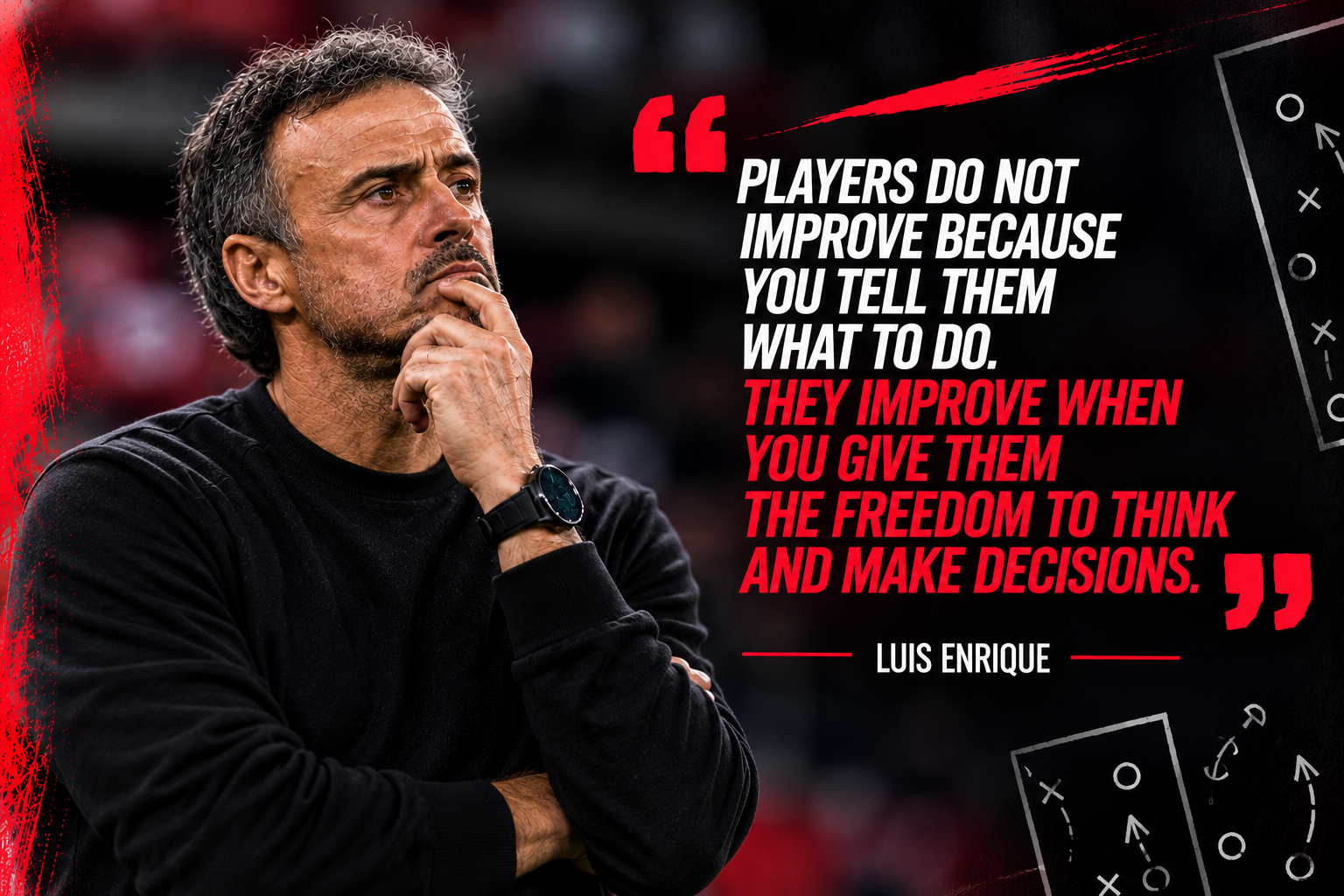
“Players do not improve simply because you tell them what to do. They improve when you give them the freedom to think and make decisions.”
This idea, inspired by the coaching philosophy of Luis Enrique, raises an important question: How much should a coach interfere with players' decisions, and when do those interventions begin to limit their development?
Football is a game of decisions. Technique, speed and physical preparation are important, but the ability to interpret situations and find solutions in real time often makes the difference.
A player may execute a perfect pass, but if he fails to recognise the right moment to play it, the quality of that execution loses much of its value.
Therefore, the coach's responsibility is not only to teach players what to do, but also to help them understand why, when and under what circumstances they should act.
1. The difference between a player who executes and one who understands
Imagine a build-up exercise.
The coach establishes a passing sequence: centre-back – defensive midfielder – full-back – winger.
The players repeat the action. The passes are accurate, the movements are correct, and the exercise works perfectly.
But what happens when the opponent blocks the defensive midfielder?
If players have only memorised the passing sequence, they may struggle to find an alternative.
However, if they understand the underlying principle — attracting the opponent, creating a free player and progressing into available space — they can identify another solution.
This is the difference between memorising an action and understanding the game.
A player who executes knows where to pass. A player who understands knows why he should pass there and when he needs to choose something different.
2. The danger of a coach who controls every decision
From the sidelines, we frequently hear instructions such as:
“Pass!” “Turn!” “Play wide!” “Don't dribble!” “Shoot!”
These interventions can be useful. The problem begins when they become the main way players make their decisions.
If the coach constantly provides the solution, players may begin waiting for instructions before acting.
Instead of observing the opponent's position, available space and teammates' movements, they focus on executing what they are told.
As a result, we may have a seemingly well-organised team whose players struggle to solve unexpected situations independently.
Tactical organisation should not be confused with dependence on the coach's instructions.
An intelligent team understands shared principles and knows how to adapt them without constantly waiting for commands.
3. Football is a game of problems, not memorised answers
During a match, situations change continuously.
The opponent changes the direction of pressing. A midfielder drops between the centre-backs. A winger moves inside. A full-back pushes forward aggressively.
Every adjustment creates new problems, but also new opportunities.
Consider a midfielder receiving the ball with his back to the opponent's goal.
Before receiving, he should identify:
-
Where is the pressure coming from?
-
Is there space to turn?
-
Which teammate is available?
-
Can he progress, or should he retain possession?
The coach can prepare players for these situations, but cannot anticipate every possible combination.
This is why training should develop a clear process:
SCAN → INTERPRET → ANTICIPATE → DECIDE → EXECUTE
The more efficiently players move through these stages, the better they can respond to the demands of the game.
4. How can we develop decision-making in training?
An important principle is to design exercises in which players do not know all the answers in advance.
For example, in a 4v4 positional game with three neutral players, the team in possession attempts to retain the ball while identifying opportunities to play a pass that breaks a line of pressure.
The coach does not necessarily determine who must receive the ball or how many passes are required before progressing.
Instead, the coach observes whether players:
-
create effective passing angles;
-
scan before receiving;
-
recognise the free player;
-
attract pressure to create space;
-
choose the right moment to progress.
After an action, the coach might ask:
“What did you see before receiving?”
“Why did you choose that pass?”
“What other solution was available?”
These questions encourage players to analyse information and understand the consequences of their decisions.
However, not every action needs to be interrupted. Sometimes it is more beneficial to allow play to continue and discuss decisions during natural breaks.
The objective is not to eliminate coaching interventions, but to make them more valuable.
5. Mistakes should become opportunities for learning
Freedom to make decisions also means having the opportunity to make mistakes.
A player attempting a difficult vertical pass may lose possession. A defender trying to beat the press by carrying the ball may be dispossessed.
If the coach's reaction is always negative, players may begin avoiding risks.
They will prefer safe solutions, even when the situation demands courage.
However, we must distinguish between a wrong decision and unsuccessful execution.
A player may identify an excellent pass that eliminates three opponents but fail to execute it accurately.
In this case, the problem is technical, not necessarily related to decision-making.
Similarly, a pass may reach its target even though it was not the most appropriate choice.
Not every loss of possession represents a poor decision, and not every successful pass represents a good one.
Coaches should evaluate both the decision-making process and its execution.
6. Freedom does not mean a lack of tactical discipline
Allowing players to make decisions does not mean allowing them to do whatever they want.
Effective freedom exists within a framework of clearly understood principles.
A team may have established rules regarding build-up play, spatial occupation, pressing and transitions.
But within these principles, players must be able to interpret situations.
For example, during build-up play, the objective may be to create a free player to overcome the opponent's first pressing line.
Sometimes the free player is the defensive midfielder. Other times, it is the full-back or goalkeeper.
The principle remains consistent. The solution changes according to the opponent.
This is one of the characteristics of an intelligent team: maintaining its collective identity without becoming predictable.
7. A good coach also knows when not to intervene
There are moments when coaching interventions are necessary. A coach may identify a collective problem, adjust the team's organisation or communicate important information.
But there must also be moments when players are allowed to make decisions independently.
If a player recognises a different solution from the one originally planned, and that solution respects the team's principles, he should have the confidence to use it.
This raises an essential question:
Do we want players who execute the coach's ideas perfectly, or players capable of discovering solutions the coach never anticipated?
Ideally, these two qualities should complement each other.
The coach provides direction, principles and organisation. The players contribute interpretation, adaptability and creativity.
Conclusion: Coaching Success Becomes Visible When Players Can Decide Independently
Developing a football player is not simply about improving technical skills or physical preparation.
It also means developing game intelligence.
A player must learn to scan before receiving, anticipate opponents' movements, recognise spaces and select appropriate solutions.
The coach must create the right environment: clear principles, realistic game problems, constructive feedback and the freedom to experiment.
Because in the decisive moment of a match, the player does not have time to wait for an explanation from the sidelines.
He must observe, understand and act.
Perhaps one of the most important signs of successful coaching is the moment when players find solutions independently, without the coach having to provide the answer.
Editorial note: The introductory quotation is an editorial formulation inspired by coaching principles associated with Luis Enrique, rather than a verified verbatim statement.
Enjoy Coach — Better Players. A Smarter Game.