
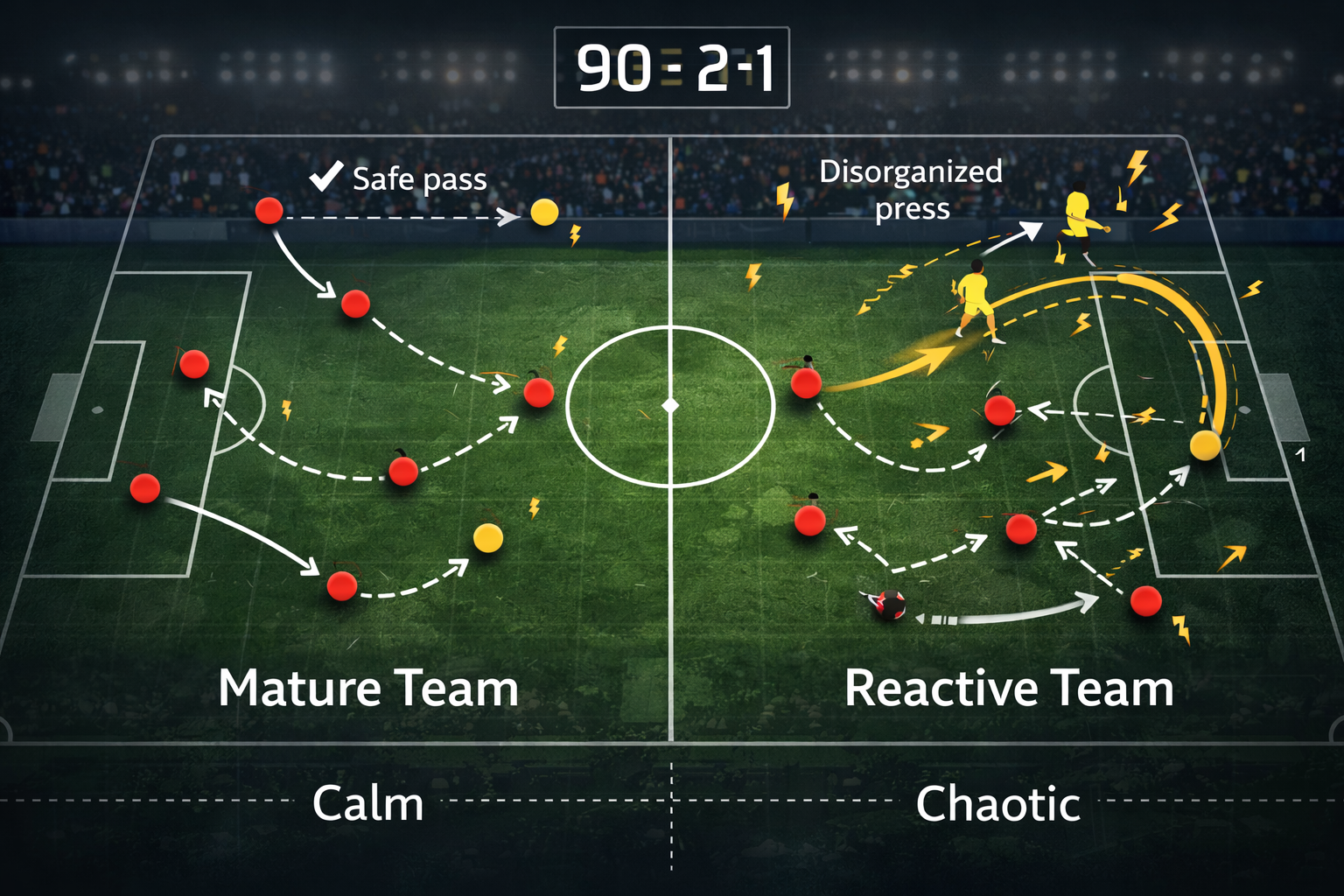
In football, the difference between a good team and a mature one does not appear when the game is under control, but in critical moments: the end of the match, a tight scoreline, pressure from the stands, accumulated fatigue. It is precisely then that transitions become tests of character, intelligence, and self-control.
This article analyses how mature teams react in transitions under maximum pressure and what coaches can do to educate decision-making, composure, and emotional control.
1. What do “Transitions under pressure” mean?
Transitions under pressure occur when:
-
the scoreline is close;
-
time is limited;
-
the stakes are high;
-
fatigue levels are elevated.
In these moments:
-
mistakes are amplified;
-
emotions influence decisions;
-
instinctive reactions can destroy organisation.
Pressure does not create mistakes — it exposes them.
2. How immature teams react
Teams lacking tactical maturity tend to:
-
accelerate without context;
-
press chaotically;
-
lose structure after every transition;
-
make individual decisions in collective moments.
The result:
-
quick loss of possession;
-
dangerous counterattacks;
-
general panic.
Under pressure, they run more — but think less.
3. How mature teams react
Mature teams do the exact opposite:
-
they slow the game down when needed;
-
they recognise moments when risk is not worth taking;
-
they maintain compactness;
-
they communicate more, not less.
They understand that:
-
not every transition must be won spectacularly;
-
sometimes the best decision is to secure the game.
Calm + structure = control.
4. Decision-making under pressure: accelerate or control?
Mature teams use a few key questions, often subconsciously:
-
Are we balanced?
-
Do we have support behind the ball?
-
Is the opponent disorganised?
-
Is the risk worth it right now?
If the answer is “no,” the decision becomes:
-
a safe pass;
-
delaying the play;
-
repositioning.
Correct decision-making under pressure is an educated behaviour, not a natural talent.
5. Emotional control in transitions
Emotions directly influence:
-
pressing timing;
-
aggression levels;
-
decision quality.
Mature teams:
-
accept difficult moments;
-
do not react impulsively;
-
use stoppages (fouls, throw-ins, corners) for mental resets.
Emotional control stabilises transitions.
6. The role of leaders in critical moments
In transitions under pressure, leaders become the team’s compass.
Key roles:
-
centre-backs — calm the block;
-
defensive midfielder — regulates tempo;
-
goalkeeper — organises and communicates.
They:
-
give clear signals (“calm”, “up”, “hold”);
-
reduce panic;
-
impose order.
Leaders do not accelerate chaos. They stop it.
7. Common mistakes under pressure
-
Forced acceleration out of frustration
-
Pressing without support
-
Immediate ball losses after regaining possession
-
Lack of communication
-
Excessive emotional reactions
8. How to train transitions under pressure
For coaches, pressure must be simulated in training.
Effective methods:
-
games with limited time and score constraints;
-
different scoring systems in the final minutes;
-
penalties for uncontrolled ball losses;
-
exercises performed under accumulated fatigue.
If you do not train pressure, you will face it unprepared in matches.
Conclusion for coaches
Transitions under pressure separate reactive teams from mature ones.
A mature team:
-
does not rush unnecessarily;
-
controls its emotions;
-
maintains structure in critical moments.
Under pressure, it is not the fastest teams that win — but the calmest ones.a