
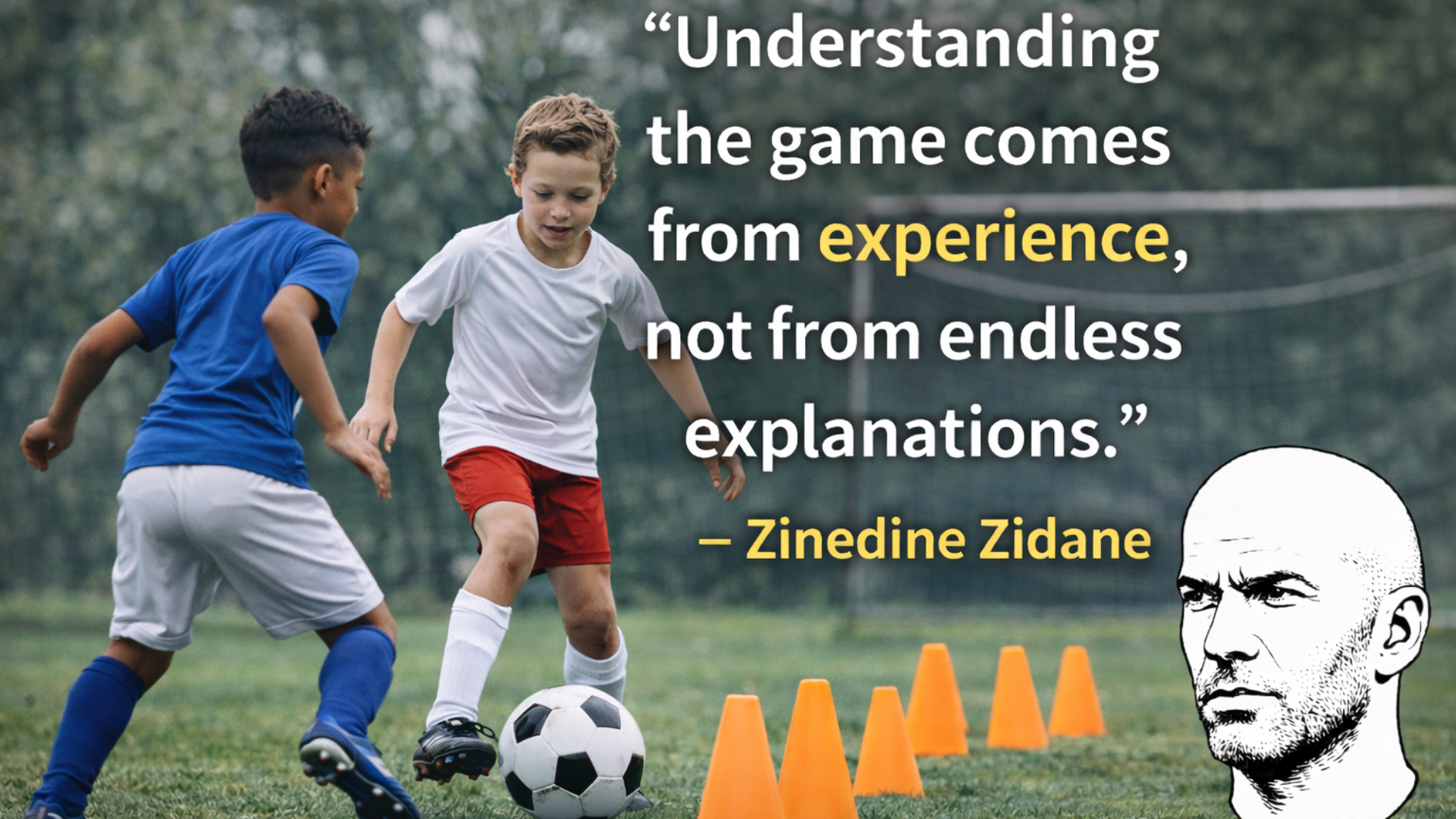
In youth football development, one of the most common traps is over-explaining.
Coaches talk too much, correct every action, and stop the game constantly. The intention is positive: to help players understand the game.
But the outcome is often the opposite.
Zinedine Zidane captures a fundamental truth of player development: game understanding is built through experience, not through endless explanations.
Football is learned by playing, not by listening
A child does not learn football the way he learns theory in a classroom.
Game understanding develops when a player:
-
experiences real game situations;
-
makes decisions under pressure;
-
makes mistakes and tries again;
-
feels the rhythm and flow of the game.
When explanations are too long or too frequent, players:
-
lose focus;
-
play mechanically;
-
look constantly for instructions;
-
stop thinking independently.
Why too many explanations slow development
In the desire to control the session, many coaches:
-
stop exercises after every mistake;
-
give solutions before players can think;
-
explain what to do instead of helping players understand why.
As a result, players begin to play to avoid mistakes, not to understand the game.
Experience is replaced by instructions, and learning becomes shallow.
Experience builds game intelligence
Zinedine Zidane, both as a player and as a coach, showed exceptional game understanding.
That understanding did not come from explanations, but from:
-
thousands of real situations on the pitch;
-
freedom to make decisions;
-
responsibility for his own choices.
Game intelligence grows when players:
-
see,
-
feel,
-
decide,
-
adapt.
Not when they simply listen.
What coaches can do in practice
To turn experience into the best teacher:
-
keep explanations short and clear, then let the game flow;
-
use questions instead of long speeches;
-
design exercises that reflect real match situations;
-
accept mistakes as a natural part of learning.
Sometimes, the best explanation is silence.

Conclusion
Zinedine Zidane’s quote is a powerful reminder for every youth coach:
players don’t need more words — they need more football.
True understanding of the game comes from experience, not from endless explanations.
If we want intelligent, adaptable players, we must give them the space to think — not just the instructions to follow.