
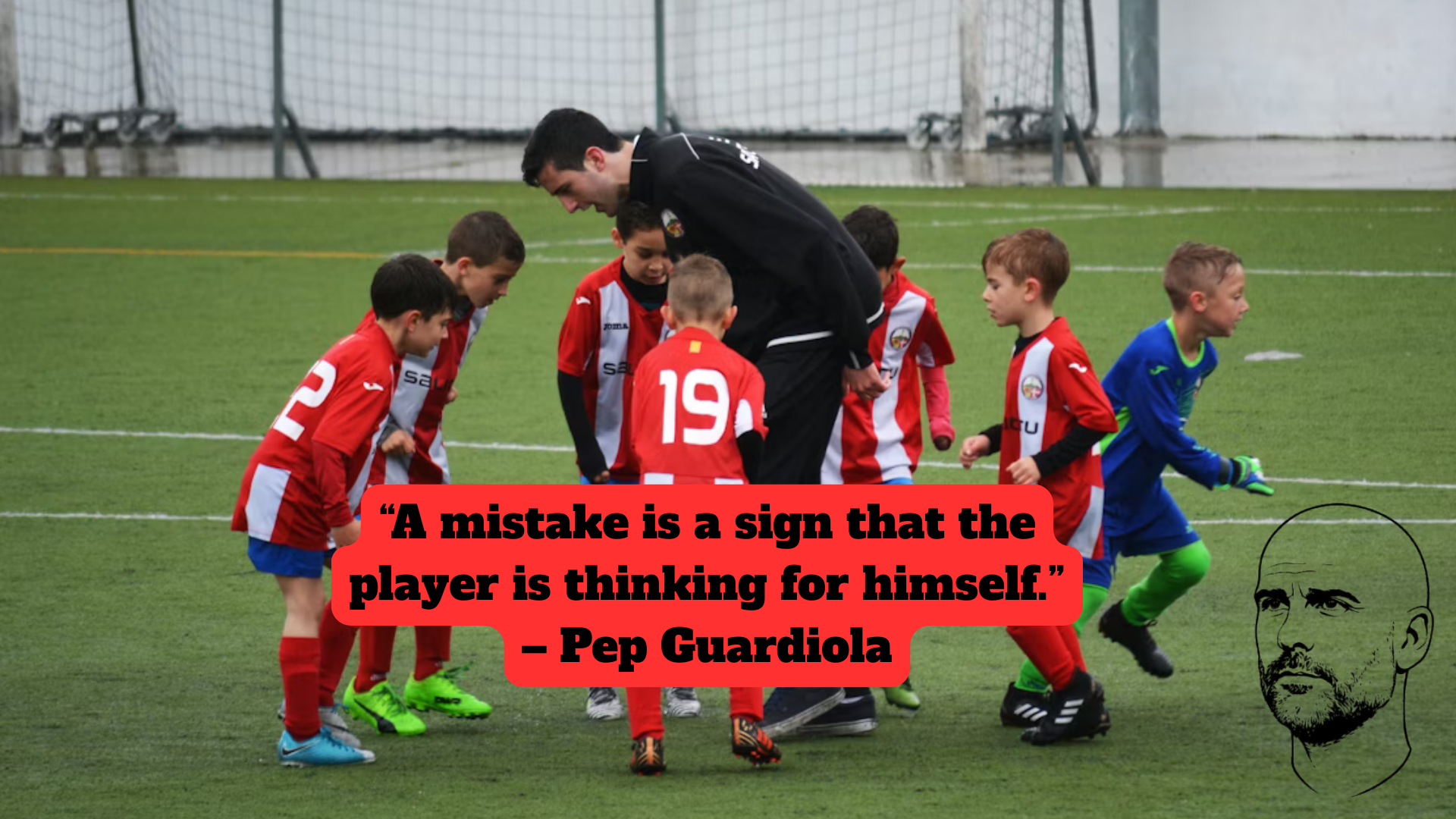
In youth football development, mistakes are often seen as failures. Something to be avoided, corrected immediately, or even punished.
Pep Guardiola offers a completely different — and deeply educational — perspective: a mistake is proof of thinking.
A child who makes mistakes is not an unprepared player. He is a player who has made a decision.
Mistakes only appear when decisions are made
A player who executes mechanically, following instructions without thinking, will rarely make mistakes. But he will also rarely improve.
On the other hand, a child who:
-
analyzes the situation,
-
evaluates different options,
-
chooses a solution independently,
will inevitably make mistakes. And this is exactly where real learning begins.
A mistake is not a lack of intelligence.
A mistake is the result of active cognitive processing.
Why coaches fear mistakes in young players
Many coaches fear mistakes because they:
-
disrupt the drill,
-
affect short-term results,
-
create visible chaos,
-
attract criticism from parents.
But a “clean” training session with no mistakes is often a session without real thinking.
Players learn to avoid risk.
To play safe.
To stay inside rigid patterns.
Intelligent players grow in permissive environments
Pep Guardiola has built teams based on:
-
autonomy,
-
responsibility,
-
decision-making freedom.
These qualities are not taught through speeches, but through training context:
-
exercises with multiple solutions,
-
small-sided games under real pressure,
-
time and space to make — and fix — mistakes.
A player who knows he won’t be punished for mistakes will have the courage to think independently.

What coaches can do in practice
To turn mistakes into a powerful learning tool:
-
stop automatic correction;
-
ask “What did you see?” instead of “Why did you do that?”;
-
praise intention, not only execution;
-
allow players to fix their own mistakes.
This shifts the focus from seeking approval to finding solutions.
Conclusion
Pep Guardiola’s quote is a lesson about the courage to think.
A child who makes mistakes is not losing control of the game — he is exploring it.
If we want intelligent, creative, and adaptable football players, we must accept a simple truth:
without mistakes, there is no thinking. Without thinking, there is no real football.