
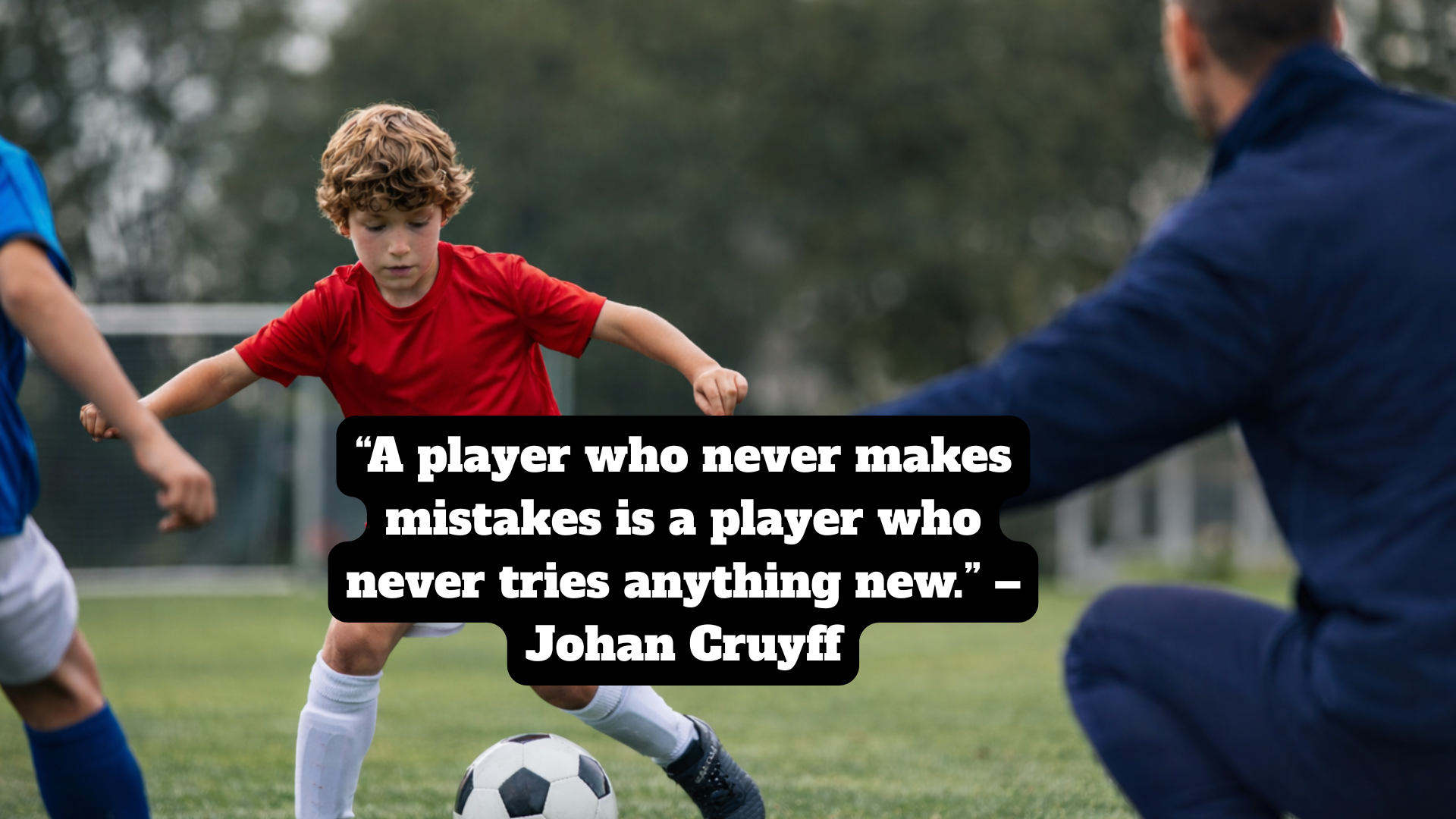
In youth football, one of the biggest barriers to development is not a lack of talent, but the fear of making mistakes.
The fear of the coach’s reaction.
The fear of parents’ comments.
The fear of losing a place in the team.
This quote by Johan Cruyff captures a painful truth: a player who never makes mistakes is not a perfect player — but a player who doesn’t dare to try.
Mistakes – a sign of courage, not weakness
Any child who attempts a risky pass, a dribble, or a quick decision under pressure will make mistakes. It’s unavoidable. But these mistakes are actually clear signs of cognitive involvement.
A child who never makes mistakes usually:
-
plays the ball backward every time;
-
avoids 1v1 situations;
-
chooses the safest option, not the best one;
-
plays just to “not stand out”.
Over time, this behavior doesn’t create intelligent players — it creates blocked players.
Why children stop trying
In most cases, children don’t choose to play cautiously on their own. They are conditioned by:
-
excessive corrections;
-
immediate punishment for mistakes;
-
constant comparisons with teammates;
-
pressure for results.
When every mistake is met with shouting, negative gestures, or being taken off the pitch, the message becomes clear:
“Don’t try.”
Real football is played in the risk zone
All great players share one common element in their childhood: freedom to experiment.
Creativity, game intelligence, and decision-making only develop when a child:
-
is allowed to make mistakes;
-
is encouraged to try again;
-
feels that a mistake does not define who they are.
Modern football demands players who think fast — not robots who execute mechanically.

What coaches can do in practice
A development-focused coach doesn’t eliminate mistakes — they use them:
-
asks questions instead of giving immediate solutions;
-
designs exercises with multiple options;
-
praises intention, not only execution;
-
allows reflection time after mistakes instead of punishment.
A simple phrase like “Good idea, try it again” can completely change a child’s behavior.
Conclusion
Johan Cruyff’s quote is not just a brilliant observation — it is a warning.
If we want brave, creative, intelligent players, we must accept mistakes as an essential part of the process.
A child who makes mistakes learns.
A child who stops trying… stops developing.