
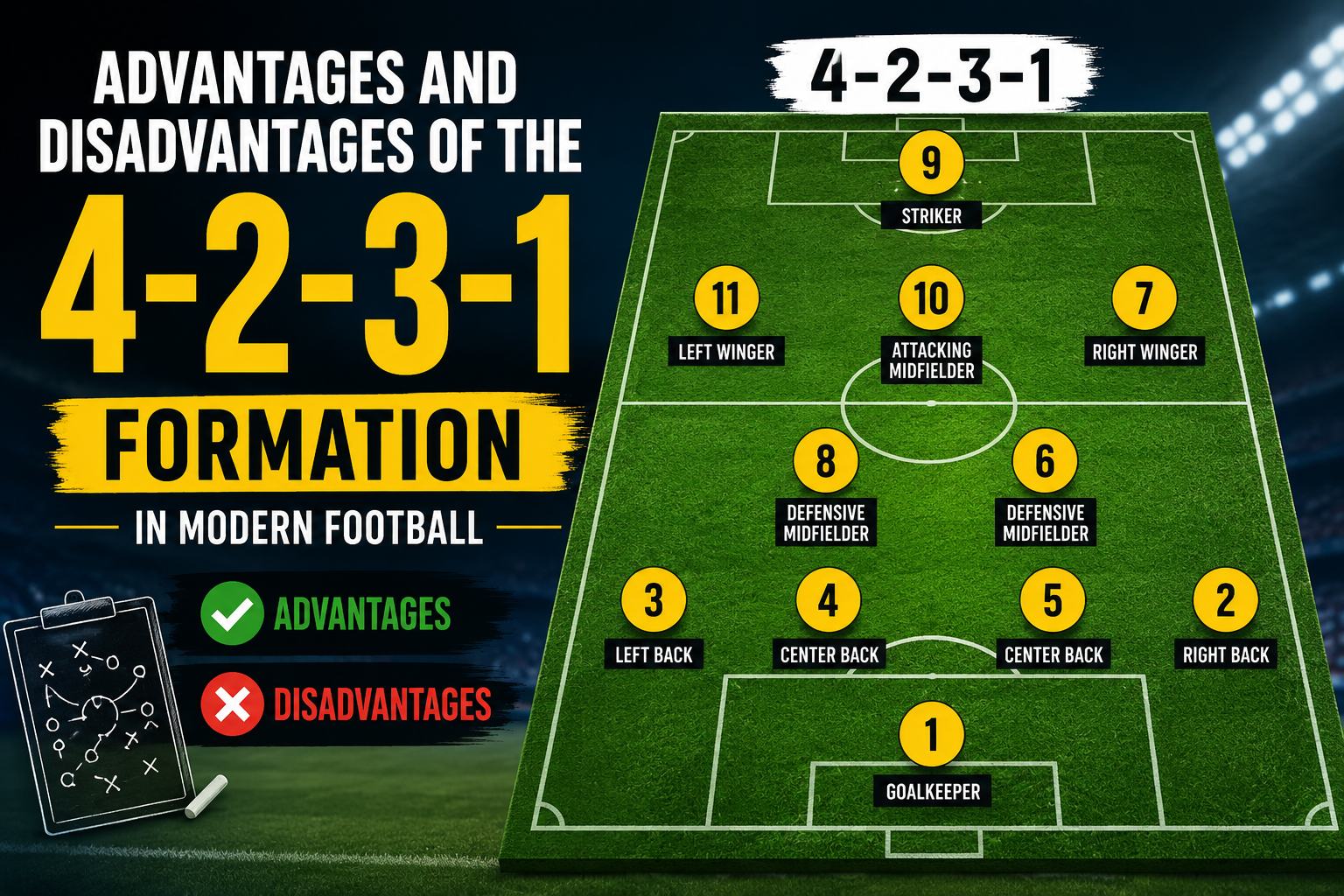
The 4-2-3-1 formation is one of the most widely used tactical systems in modern football. From elite-level teams to youth academies, many coaches choose this structure because of the balance it provides between attacking and defensive phases of the game.
Its popularity comes from its flexibility. The system allows teams to build attacks effectively, control central areas, and quickly adapt to different moments of the match. However, like any tactical formation, the 4-2-3-1 is not perfect. Its effectiveness depends on the players available, the team's playing principles, and the overall tactical organization.
In this article, we will explore the main advantages and disadvantages of the 4-2-3-1 formation and understand why it has become one of the most successful systems in modern football.
Advantages of the 4-2-3-1 formation
1. Balance between attack and defense
One of the greatest strengths of the 4-2-3-1 formation is the balance it offers.
The two defensive midfielders provide protection in front of the back line, while the four attacking players can actively contribute to creating and finishing attacking moves. This allows the team to attack with numbers while maintaining defensive stability.
2. Superior control in central areas
With two central midfielders and an attacking midfielder, teams can create numerical superiority in the middle of the pitch.
This helps to:
- Maintain possession.
- Progress the ball through passing combinations.
- Control the tempo of the game.
- Recover possession quickly after losing the ball.
In modern football, where controlling central spaces is crucial, this advantage becomes extremely valuable.
3. High tactical flexibility
The 4-2-3-1 can easily transform into different structures depending on the phase of play:
- 4-4-2 during the defensive phase.
- 4-3-3 in possession.
- 4-2-4 during sustained attacking situations.
- 4-5-1 in a low or medium defensive block.
This flexibility provides coaches with multiple tactical solutions without requiring a complete change in the team's organization.
4. Better support for the striker
Many formations that use a single striker risk leaving the forward isolated.
In a 4-2-3-1, the attacking midfielder and wide players can consistently support the striker, creating passing combinations and goal-scoring opportunities.
As a result, the striker is less likely to be left alone against the opposition center backs and usually has more passing and combination options.
5. Effective pressing structure
The positioning of the players allows teams to organize coordinated pressing actions.
The front four — consisting of the striker, attacking midfielder, and two wingers — can block passing lanes and force opponents into specific areas of the pitch.
This is one of the reasons why many high-pressing teams successfully use variations of the 4-2-3-1 formation.
Disadvantages of the 4-2-3-1 formation
1. Dependence on the quality of the attacking midfielder
The number 10 plays a crucial role in this system.
This player must:
- Create chances.
- Find spaces between the lines.
- Connect midfield and attack.
- Contribute to pressing actions.
If a team lacks a player capable of performing these responsibilities effectively, the system's overall performance can suffer significantly.
2. High physical and tactical demands on wingers
Wide players are expected to contribute in both attacking and defensive phases.
They must:
- Provide width in attack.
- Support goal-scoring actions.
- Track opposition full-backs.
- Help form the defensive block.
This dual responsibility requires players with strong physical capacity and tactical understanding.
3. Vulnerability between the lines
If the distances between units become too large, opponents can exploit the spaces between midfield and defense.
This often occurs when:
- Defensive midfielders are pulled too high up the pitch.
- The defensive line drops too deep.
- The team loses compactness.
Maintaining vertical and horizontal compactness is one of the key requirements of the 4-2-3-1 system.
4. Risk of striker isolation
Although the system is designed to support the lone striker, the forward can still become isolated if:
- Wingers remain too wide.
- The attacking midfielder does not occupy nearby supporting positions.
- Ball circulation is too slow.
In these situations, the striker may find himself battling alone against multiple defenders.
5. Requires complete central midfielders
The two defensive midfielders must possess a wide range of qualities, including:
- Ball-winning ability.
- Positional discipline.
- Passing quality.
- Tactical intelligence.
If one of these players struggles to perform his role effectively, the team may quickly lose control of central areas.
Conclusion
The 4-2-3-1 remains one of the most effective and versatile formations in modern football. It offers a strong balance between attack and defense, provides excellent control of central spaces, and allows teams to adapt to different opponents and game situations.
However, the success of the system depends on much more than player positioning. To maximize its potential, coaches must ensure that players understand their roles, apply clear playing principles, and work within a well-organized collective structure.
Ultimately, formations do not win matches on their own. Success comes from the coach's ability to transform a tactical structure into a clear game model that fits the characteristics of the players and the team's football philosophy.
Do you use the 4-2-3-1 formation with your team? What do you consider its biggest advantage and biggest disadvantage? ⚽