Not all transitions are the same. The major difference is not only the moment (loss or recovery of possession), but the place where the transition occurs. A transition in the central zone has completely different tactical implications compared to one in the wide areas, and coaches who fail to make this distinction treat different situations with the same solutions.
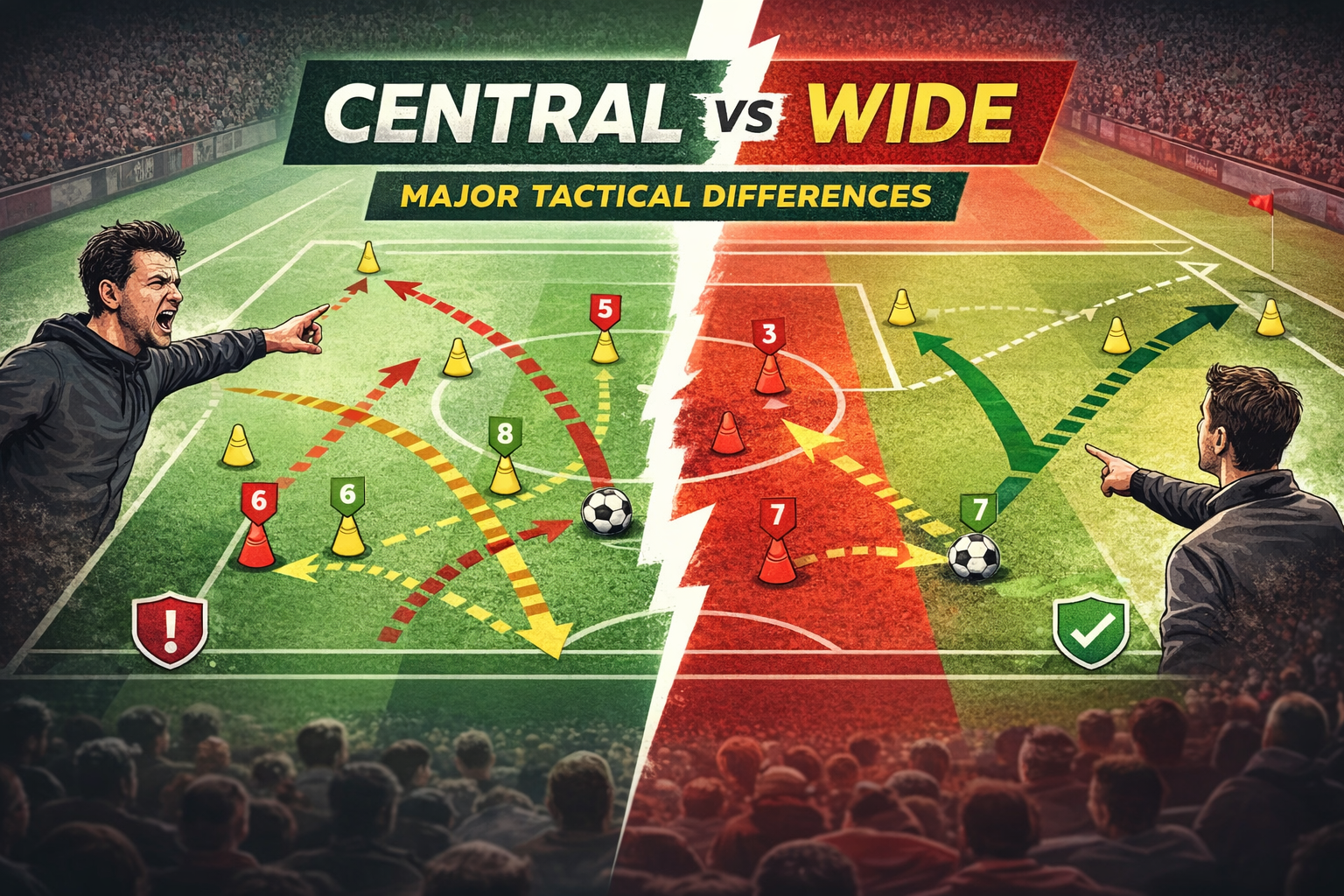
This article clarifies the major tactical differences between central and wide transitions, analyzing space, risk, and decision-making.
1. Why does the zone of transition matter?
The area of the pitch determines:
-
passing angles;
-
speed of progression;
-
level of risk;
-
decision-making time.
Where you lose or regain the ball dictates what you must do in the next few seconds.
2. Transitions in central areas – high risk, quick decisions
Main characteristics
The central zone is:
-
the shortest path to goal;
-
the space with the most options;
-
the area with the highest defensive risk.
A transition in the center offers:
-
direct access to finishing;
-
quick vertical passes;
-
continuity in attack.
That is why losses in central areas are the most dangerous.
Negative transition in central areas
After losing the ball in the center, the priorities are clear:
-
protecting the central axis
-
blocking vertical passes
-
slowing down the ball carrier
-
immediate compactness
The correct decision:
-
immediate, short, collective pressing
-
or quick retreat if the ball has passed the pressure zone
Common mistake:
individual challenges → large space left behind.
Positive transition in central areas
After regaining the ball in the center:
-
accelerate only if there is real space;
-
look for players facing the goal;
-
avoid immediate loss of possession.
In central areas, one wrong decision counts double.
3. Wide transitions – controllable risk, guided decision
Main characteristics
Wide areas:
-
limit the opponent’s angles;
-
provide defensive support (touchline);
-
reduce direct access to goal.
Wide transitions are:
-
more predictable;
-
easier to control;
-
ideal for defensive directing.
Negative transition on the wing
After losing the ball wide:
-
pressing is safer;
-
directing is clearer;
-
risk is lower.
Priorities:
-
forcing the opponent toward the sideline;
-
quick cover;
-
blocking the return to the center.
The wing is the defensive ally.
Positive transition on the wing
After regaining the ball wide:
-
you can accelerate through progression on the flank;
-
or reset play toward the center.
The decision depends on:
-
inside support;
-
opponent positioning;
-
number of players in the area.
The wing offers time, not necessarily quick solutions.
4. Space: center vs wide
| Aspect | Central zone | Wide zone |
|---|---|---|
| Passing angles | Many | Limited |
| Access to goal | Direct | Indirect |
| Defensive risk | Very high | Medium |
| Decision time | Very short | Longer |
| Pressing | Risky | Safer |
5. Decision – the element that makes the difference
The same rule does NOT work in both zones.
-
In the center: control before speed
-
On the wing: direction before recovery
Intelligent teams:
-
press differently depending on the zone;
-
accelerate selectively;
-
adapt collective behavior.
6. Common team mistakes
-
aggressive pressing in the center without support
-
forced acceleration after central recovery
-
lack of cover on the wing
-
the same reaction in any zone
-
individual decisions in collective moments
7. How to train the differences between transitions
For coaches:
-
small-sided games with clear zoning;
-
different rules for center vs wide;
-
different scoring depending on decision;
-
stoppages to correct context.
Do not ask “why didn’t you run?”, ask “which zone was it?”
Conclusion for coaches
Transitions are not only about speed, but about space and decision.
A mature team:
-
treats the center with respect;
-
uses the wing as an ally;
-
adapts reaction to context.
Tell me where you lose the ball, and I’ll tell you what decision you must make.