
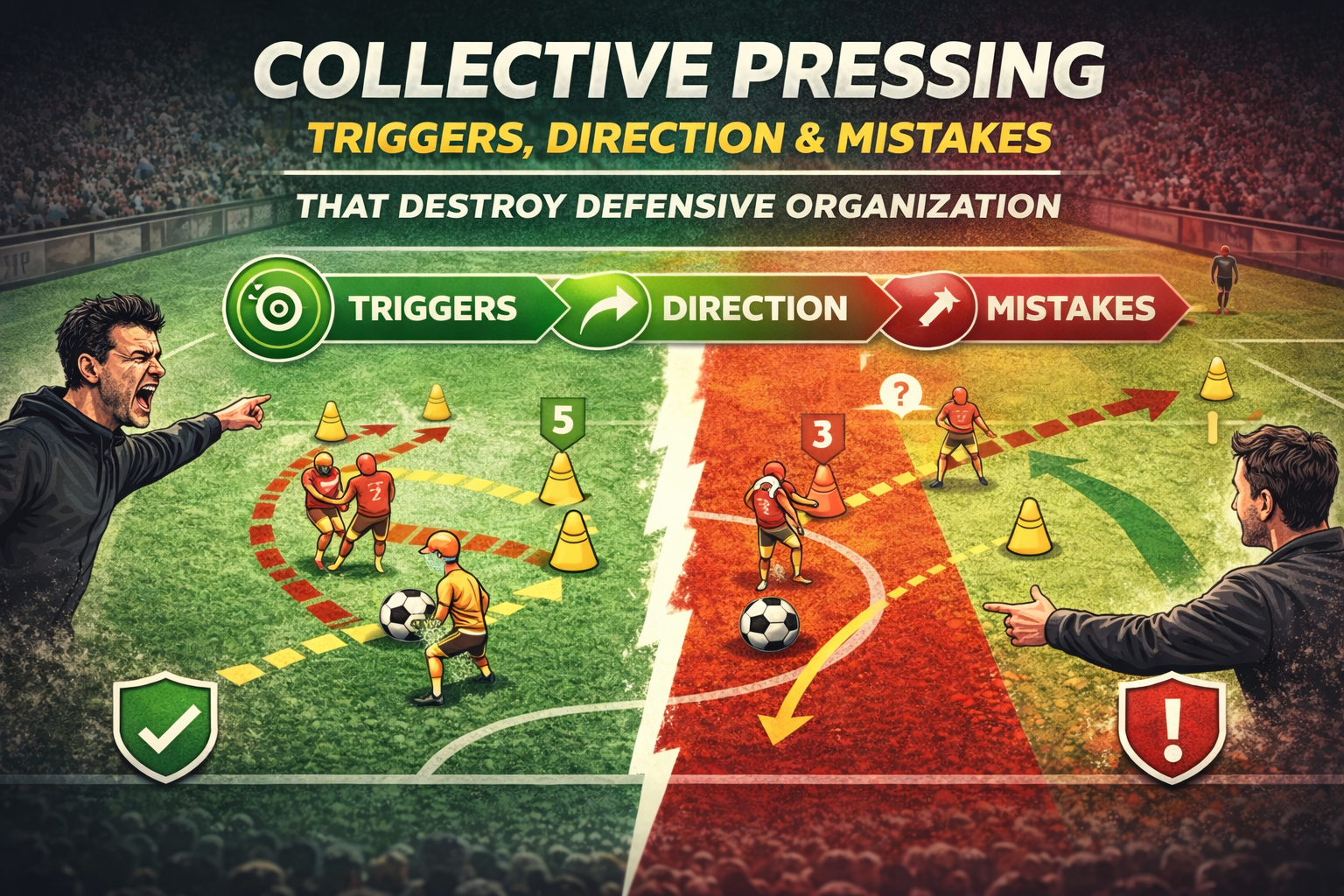
Pressing is one of the most misunderstood components of the defensive phase. Many confuse it with intensity, constant running, or individual aggression. In reality, collective pressing is an organized mechanism built on clear triggers, intelligent direction, and synchronization between players.
This article explains when to press, who initiates the press, and how to avoid meaningless running that breaks defensive organization.
1. What is collective pressing, really?
Collective pressing is the coordinated action of multiple players to limit the time, space, and options of the opponent in possession.
It is not:
-
permanent sprinting;
-
individual attacks on the ball;
-
a display of physical effort.
It is:
-
a tactical decision;
-
triggered at the right moment;
-
supported by the entire defensive block.
Good pressing looks calm and controlled, not chaotic.
2. When do you press? The importance of triggers
Pressing does not happen “by desire,” but by signal.
What are pressing triggers?
They are clear situations indicating that the opponent is vulnerable.
The most common triggers:
-
poor first touch;
-
slow or backward pass;
-
player receiving with back to play;
-
isolated opponent;
-
reception near the sideline;
-
aerial ball or loose rebound.
Without triggers, pressing becomes useless running.
3. Who initiates the press?
Most often, the first defensive line (forwards / wingers) is responsible for initiating.
Roles are clear:
-
the player closest to the ball initiates;
-
nearby teammates provide support;
-
deeper lines advance to reduce space.
Important:
Pressing is initiated by one, but executed by all.
A single player does not press — he simply runs without purpose.
4. Directing play – the key to effective pressing
The aim of pressing is not only ball recovery, but directing the opponent.
Correct direction involves:
-
closing central areas;
-
forcing play wide or backward;
-
using the touchline as a defensive ally.
The angle of approach is more important than speed:
-
body oriented toward the sideline;
-
blocking the supporting foot;
-
anticipation, not chaotic tackling.
5. Pressing and distances between lines
Pressing works only if the team is compact.
Essential conditions:
-
short distances between players;
-
midfield line close to the first line;
-
defensive line stepping up to reduce space.
If distances are large:
-
the opponent easily plays over the press;
-
gaps appear between lines;
-
the team becomes stretched.
Pressing without compactness = invitation to counterattack.
6. Common mistakes that destroy defensive organization
Individual pressing
One player runs alone → large spaces behind.
Lack of synchronization
One presses, others stay deep → broken line.
Pressing without direction
Running straight to the ball → opponent escapes easily.
Pressing in wrong zones
Pressing centrally without support → imbalance.
Lack of communication
Players unsure whether to step up or hold.
7. How to train collective pressing
For coaches, pressing must be:
-
explained, not assumed;
-
trained progressively;
-
integrated into realistic game scenarios.
Recommendations:
-
small-sided games with limited zones;
-
clear triggering rules;
-
short stoppages for collective correction.
Correct the decision, not just the effort.
Conclusion for coaches
Collective pressing is not about running more, but about running together and intelligently.
Effective pressing:
-
has clear triggers;
-
is directed;
-
maintains defensive organization.
Good pressing saves energy and gains control.