
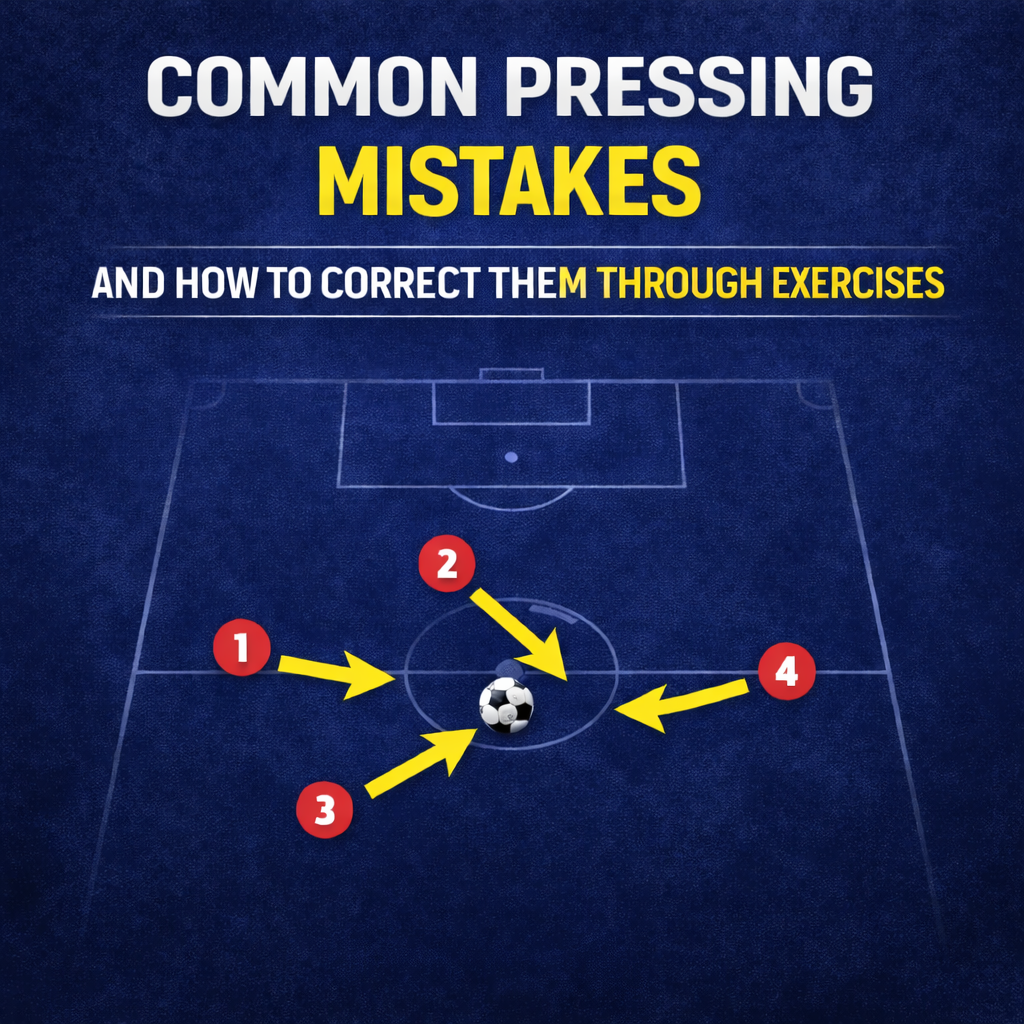
Pressing is one of the most effective defensive weapons when it is correctly understood and trained. The problem appears when pressing is reduced to running a lot, without clear rules, without support, and without connection with the rest of the team. In such cases, pressing not only does not help, but destroys the defensive organization.
This article is 100% applied, designed for coaches, and makes the direct connection between mistake → cause → correction exercise.
1. Mistake: individual pressing, without support
How it appears in the game
- one player runs alone toward the ball;
- the opponent plays easily over the press;
- large spaces appear between the lines.
Causes
- lack of clear triggers;
- the desire to “show involvement”;
- large distances between players.
Correction through exercises
SSG 3 vs 3 + 3 neutrals
- pressing allowed only if there is close support;
- the recovery is valid only if at least two players are involved.
You educate the idea that pressing is collective, not individual.
2. Mistake: pressing without compactness
How it appears in the game
- forwards press high;
- midfielders stay low;
- the team splits in two.
Causes
- lack of coordination between lines;
- fear of the ball played behind;
- poor communication.
Correction through exercises
5 vs 5 game on a short field (vertical limit)
- field shortened in length;
- short stoppages to adjust the positions of the lines.
Pressing works only with a short team.
3. Mistake: pressing triggered in inappropriate zones
How it appears in the game
- aggressive pressing in the center;
- the opponent escapes easily from the pressure;
- direct access toward the goal.
Causes
- lack of knowledge of favorable zones;
- lack of direction.
Correction through exercises
SSG with zoning (center vs wide area)
- free pressing allowed in wide areas;
- pressing in the center only with numerical superiority.
Players learn where it is safe to press.
4. Mistake: permanent pressing, without pauses
How it appears in the game
- the team gets tired quickly;
- decision quality decreases;
- unnecessary fouls appear.
Causes
- pressing understood as a constant obligation;
- lack of rhythm management.
Correction through exercises
Game with pressing intervals
- pressing allowed only on signal (verbal or visual);
- alternation pressing – mid block.
Pressing is selective, not continuous.
5. Mistake: lack of pressing direction
How it appears in the game
- running directly toward the ball;
- the opponent escapes easily from the pressure;
- lack of control over the direction of play.
Causes
- wrong approach angles;
- poor body positioning.
Correction through exercises
2 vs 2 + 1 goalkeeper exercise, with direction
- points only if the opponent is forced wide;
- focus on body position and angle.
You educate intelligent pressing, not sprinting.
6. Mistake: lack of communication in pressing
How it appears in the game
- players do not know whether to step up or stay;
- delayed reactions;
- disorganized pressing.
Causes
- unclear roles;
- passive defensive leaders.
Correction through exercises
SSG with mandatory communication
- the action is not valid without a verbal command;
- clear roles for CB, DM, GK.
Communication is part of the pressing mechanism.
7. Mistake: focus on effort, not on decision
How it appears in the game
- players who run a lot, but inefficiently;
- pressing easy to beat;
- frustration.
Causes
- feedback focused only on intensity;
- lack of decision correction.
Correction through exercises
SSG with points for the correct decision
- points for the correct pressing moment;
- no points for useless running.
Players learn when, not only how.
Conclusion for coaches
Pressing does not fail because of lack of effort, but because of:
- lack of rules;
- lack of context;
- lack of appropriate exercises.
A well-corrected pressing:
- saves energy;
- maintains defensive organization;
- increases team efficiency.
Do not correct pressing through shouting. Correct it through exercises.