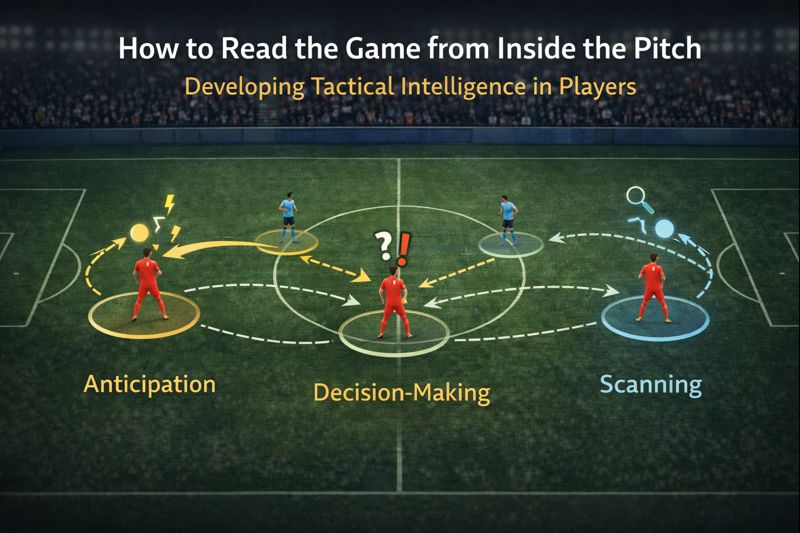
Tactical intelligence does not mean knowing patterns or schemes — it means understanding what is about to happen. Players who “read the game” always seem one step ahead: they choose the right solution, arrive first to the ball, and make simple actions look easy. This ability is built through decision-making, anticipation, and scanning.
1. Reading the game starts before receiving the ball
Intelligent players do not react after their first touch — they decide before it. They constantly search for information: opponents’ positions, free space, nearby options.
The game is read with the head up, not with the ball at your feet.
2. Scanning is the foundation of decision-making
Scanning means:
-
repeated looks before receiving the ball;
-
body orientation towards the game;
-
constant updating of information.
Without scanning, decisions are delayed or incorrect.
3. Anticipation reduces the need for speed
Players who anticipate:
-
move earlier;
-
position themselves better;
-
win duels without unnecessary sprints.
Anticipation beats speed.
4. Good decisions are context-dependent
There is no universal “correct” solution. Every decision depends on:
-
the area of the pitch;
-
the level of opponent pressure;
-
the scoreline and the moment of the game.
Tactical intelligence means adaptation, not mechanical execution.
5. Game reading is position-specific
-
centre-backs anticipate passes and depth;
-
central midfielders read transitions and protect the centre;
-
attacking midfielders see spaces between the lines;
-
strikers read defenders’ movements.
Tactical education must be adapted to each role.
6. Small-sided games develop tactical intelligence
Well-designed SSGs:
-
increase decision-making frequency;
-
force scanning;
-
expose players to real pressure.
Less explanation, more contextual play.
7. Questions educate better than commands
“What did you see?”
“Why did you choose that?”
“What other option did you have?”
These questions build thinking, not just execution.
Conclusion for coaches
Tactical intelligence cannot be taught from a tactics board.
It is built through:
-
repeated exposure to real situations;
-
constant scanning;
-
controlled freedom in decision-making.
Players who read the game do not play faster.
They play better.