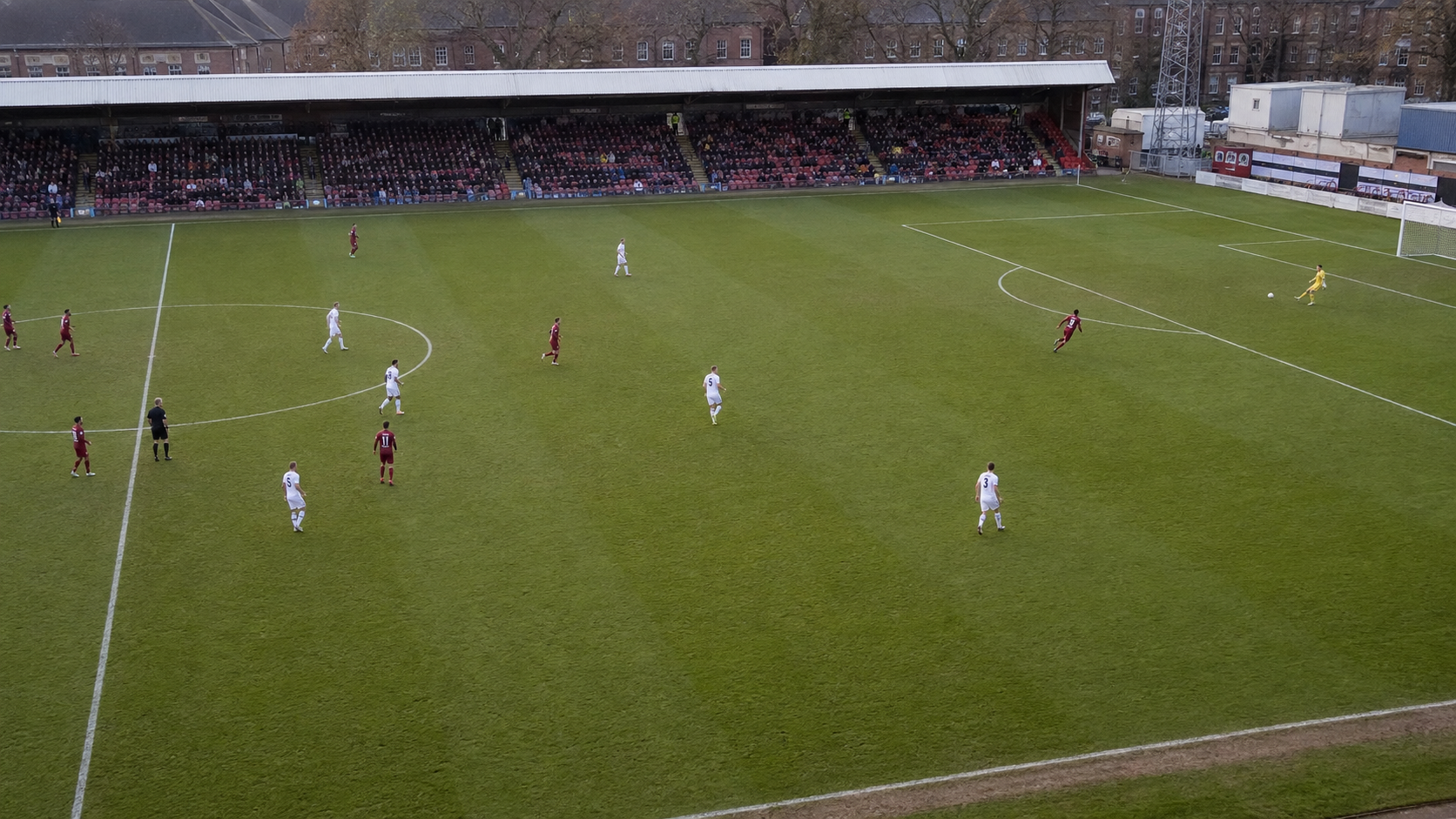
A back pass to the goalkeeper is an important pressing trigger, but the team’s reaction must be adapted to the length of the pass. A short pass from near the penalty area and a long pass from the halfway line create different tactical situations.
The question is not simply whether the ball reaches the goalkeeper, but:
How much time does the team have to advance, and which options can it close before the goalkeeper plays the ball?
The short pass to the goalkeeper
A short back pass usually occurs when a defender near their own penalty area uses the goalkeeper as a supporting option. The striker is generally close to the action, but the ball reaches the goalkeeper quickly.
The reaction must be immediate:
- the striker presses along a curved path and blocks one passing option;
- the wingers advance towards the full-backs;
- the midfielders close the passing lane into the pivot;
- the defensive line steps forward to maintain compactness.
The main danger is a quick first-time pass towards the opposite side. If the team reacts too late, the goalkeeper can bypass the press with a single pass.
A short back pass requires explosive and perfectly coordinated pressure.
The long pass from the halfway line
A long back pass to the goalkeeper provides more time to organise the press, but it also requires the team to cover a greater distance.
The press must be prepared while the ball is travelling:
- the striker selects the direction of the press and approaches under control;
- the wingers take responsibility for the full-backs;
- the midfielders step forward and protect the centre;
- the defensive line pushes the block higher;
- the team prepares for a long clearance and the second ball.
The striker should arrive close to the goalkeeper as the first touch is taken and guide them towards their weaker foot or the prepared wide area.
The main danger is a long pass over the press. If the defensive line fails to advance, the team becomes stretched and the opponent can win the second ball.
A long back pass requires progressive and coordinated movement from the entire team.
Distance is Not the only factor
The speed and accuracy of the pass are equally important. A powerful long pass may reach the goalkeeper quickly, while a slow or inaccurate short pass can offer an excellent opportunity to regain possession.
The players must assess:
- the ball’s travelling time;
- the distance to the goalkeeper;
- the goalkeeper’s body orientation;
- the foot on which the goalkeeper receives;
- the positioning of teammates;
- the team’s preparation for a long pass.
The real trigger is not simply the back pass, but the relationship between the distance of the pass, the available time and the team’s organisation.
Conclusion
Short and long back passes to the goalkeeper should not be pressed in the same way.
After a short pass, react quickly and close the available options immediately. After a long pass, use the ball’s travelling time to advance together and compress the pitch.
Intelligent pressing is not triggered mechanically. It must be adapted to the length, speed and quality of the pass, as well as the positioning of the entire team.