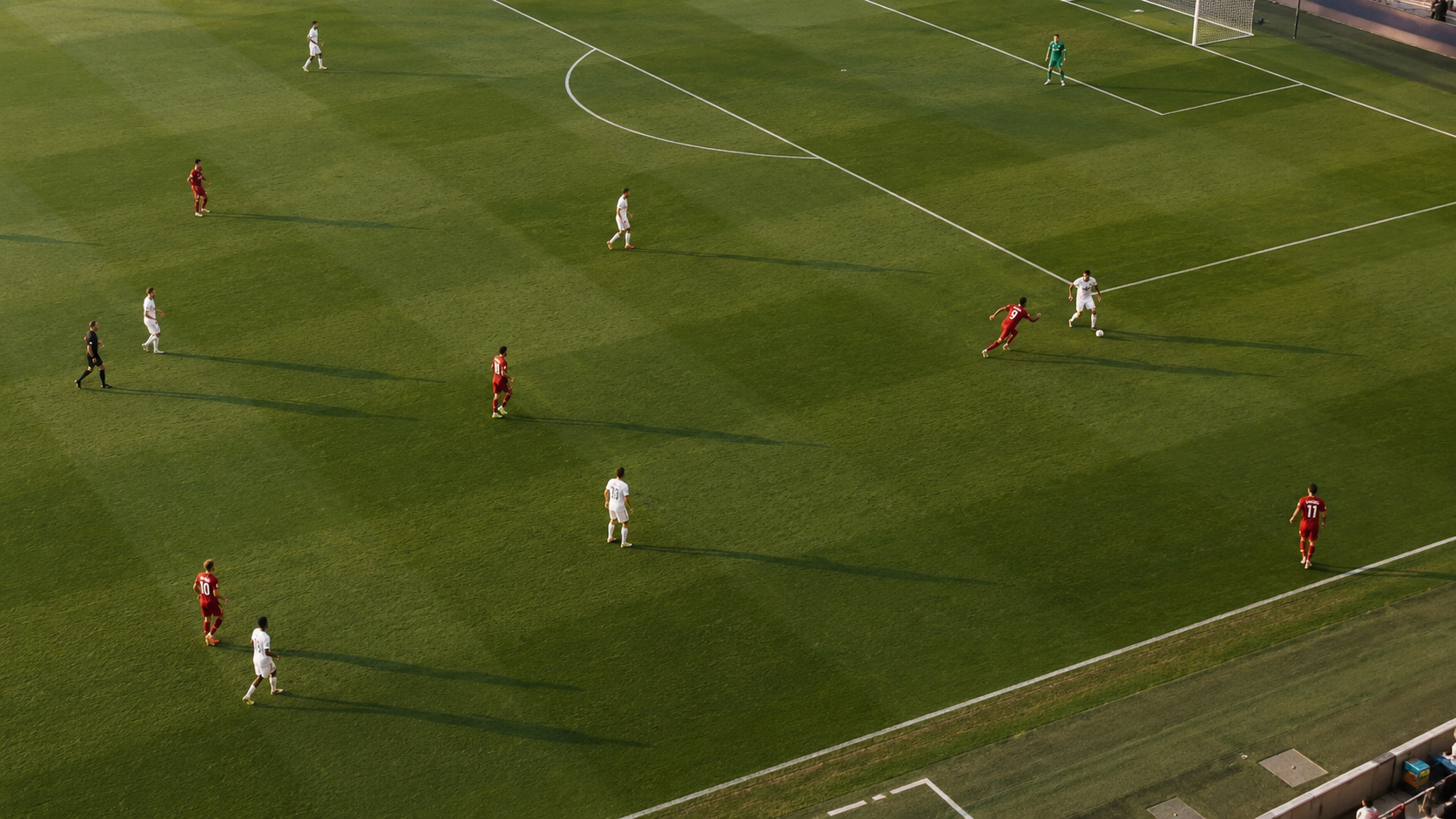
In a team’s pressing organisation, the striker is the first defender. Their role is not limited to running towards the defender in possession or trying to regain the ball individually. Their main responsibility is to establish the direction of the press and influence the opponent’s next decision.
Through positioning, body orientation and the angle of approach, the striker can close certain passing options while intentionally leaving open the route towards the area where the team is prepared to intervene.
The idea is simple: the striker does not merely chase the ball; they try to control its path.
The striker is the first defender
The press begins before the striker accelerates towards the ball. Their starting position should allow them to observe the ball carrier, the nearby opponents and the passing lanes the team wants to block.
A well-positioned striker can limit the opposition’s build-up without wasting energy. They reduce the centre-back’s time, protect access to central areas and force the defender to choose a predictable option.
Even without regaining possession, the striker fulfils their role when they force the opponent to play:
- towards the touchline;
- towards the defender who is less comfortable in possession;
- onto a player’s weaker foot;
- backwards to the goalkeeper;
- a long pass that is difficult to control;
- into an area where the pressing team can create a numerical advantage.
The angle of approach determines the direction of the press
One of the most important aspects of the striker’s action is the angle from which they approach the ball carrier. If they run directly towards the opponent, the defender may retain several passing options and bypass the pressure relatively easily.
A curved run, however, allows the striker to pressure the ball while simultaneously blocking an option behind them.
For example, when the team wants to direct the build-up towards the flank, the striker can press the centre-back from the inside towards the outside. This trajectory protects the pass into the pivot or towards the other centre-back and invites the opponent to play wide.
This invitation is not a weakness in the press. It is an option deliberately offered to guide the ball into the team’s prepared trap.
The cover shadow
The striker can block an opponent without positioning themselves directly next to them. By using the correct body angle, the pressing player can keep an opponent or passing lane behind them. This area is known as the cover shadow.
For example, the striker can press the centre-back while keeping the opposition’s pivot within their cover shadow. This allows them to pressure the ball and prevent central progression at the same time.
For this behaviour to be effective, the striker must continually adjust their position. A small change in angle can open the pass into the pivot and allow the opposition to bypass the first line of pressure.
Recognising pressing triggers
The striker must recognise the moments when the pressure can be intensified. Not every pass or situation requires the same speed of intervention.
Common pressing triggers include:
- a slow pass between the centre-backs;
- a poor first touch;
- receiving the ball with the back to the direction of play;
- a backward pass to the goalkeeper;
- receiving the ball on the weaker foot;
- a defender positioned close to the touchline;
- a lack of nearby passing options for the ball carrier.
The striker must identify the trigger and initiate the press decisively. Their action signals to the rest of the team that it is time to step forward, reduce the available space and assume their defensive responsibilities.
The connection with the midfielders and wingers
The striker’s press cannot function in isolation. Behind them, the midfielders must protect central areas, while the wingers must be ready to press passes towards the full-backs.
If the striker guides the ball wide but the winger is slow to step forward, the opponent will have enough time to control the ball and find a solution. If the midfielders fail to reduce the distances, a simple pass into the centre may eliminate several players from the defensive action.
The relationships must be clear:
- the striker establishes the direction;
- the winger closes the trap in the wide area;
- the midfielders block the inside passes;
- the defensive line steps forward and keeps the team compact;
- the players on the opposite side shift towards the ball.
The striker initiates the action, but its effectiveness depends on the response of the entire team.
Real pressure, Not symbolic running
The striker must get close enough to genuinely influence the opponent’s decision. If they remain too far away, the defender will have time to look up, carry the ball forward and choose the best available solution.
However, an uncontrolled approach can be bypassed with a simple dribble or change of direction. The striker should accelerate during the first part of the run before adjusting their steps and body position as they approach the opponent.
The objective is to reduce the opponent’s time and space while maintaining the direction the pressing team wants to impose.
When should the press be abandoned?
An intelligent striker must also recognise when the press can no longer continue. If the opponent has bypassed the first line, the distances between teammates are too large or the ball has entered an unprotected area, continuing to chase may unbalance the team.
In this situation, the striker must recover their position within the defensive block. They can block the backward pass, control the opposition’s pivot or prepare for the next pressing opportunity.
Tactical discipline means recognising both the moment to attack the ball and the moment to stop and reorganise.
Common mistakes
One of the most common mistakes is running directly towards the ball carrier. The striker makes a physical effort but fails to block any important option, allowing the opponent to decide the direction of the build-up.
Another mistake is initiating the press without support from teammates. If the striker moves too early, the distance between them and the midfielders increases, enabling the opposition to play into the space left open.
Other problems occur when the striker:
- fails to protect the pass into the pivot;
- changes the direction of the press without a tactical reason;
- approaches too slowly and gives the opponent time;
- runs intensely without adjusting the angle of approach;
- continues pressing after the first line has been bypassed.
These mistakes demonstrate that pressing effectiveness cannot be measured only by the distance covered. It must also be evaluated through the options the striker successfully removes.
How can we train the striker’s role?
This behaviour can be developed through games in which the opposition begins its build-up from the goalkeeper and centre-backs. The defending team is tasked with guiding the ball towards a wide channel or a specific player.
The coach can award additional points for:
- regaining possession in the designated area;
- forcing the opposition to play backwards;
- blocking the pass into the pivot;
- provoking a long pass;
- winning the ball after the agreed pressing trigger.
The exercises should allow the striker to recognise situations and make decisions. Repeating a predetermined running pattern is not enough. The player must understand why a particular angle is chosen and which reactions it should provoke from the opposition.
Conclusion
The striker plays an essential role in the team’s defensive organisation. Through positioning, the angle of approach and the use of the cover shadow, they can limit the opponent’s build-up and guide the ball towards the area where the team wants to regain possession.
The message to the striker should be clear:
Do not press only to reach the ball. Press to decide where the ball will go.
An effective striker is not merely the first player to run. They are the player who gives direction to the entire press.