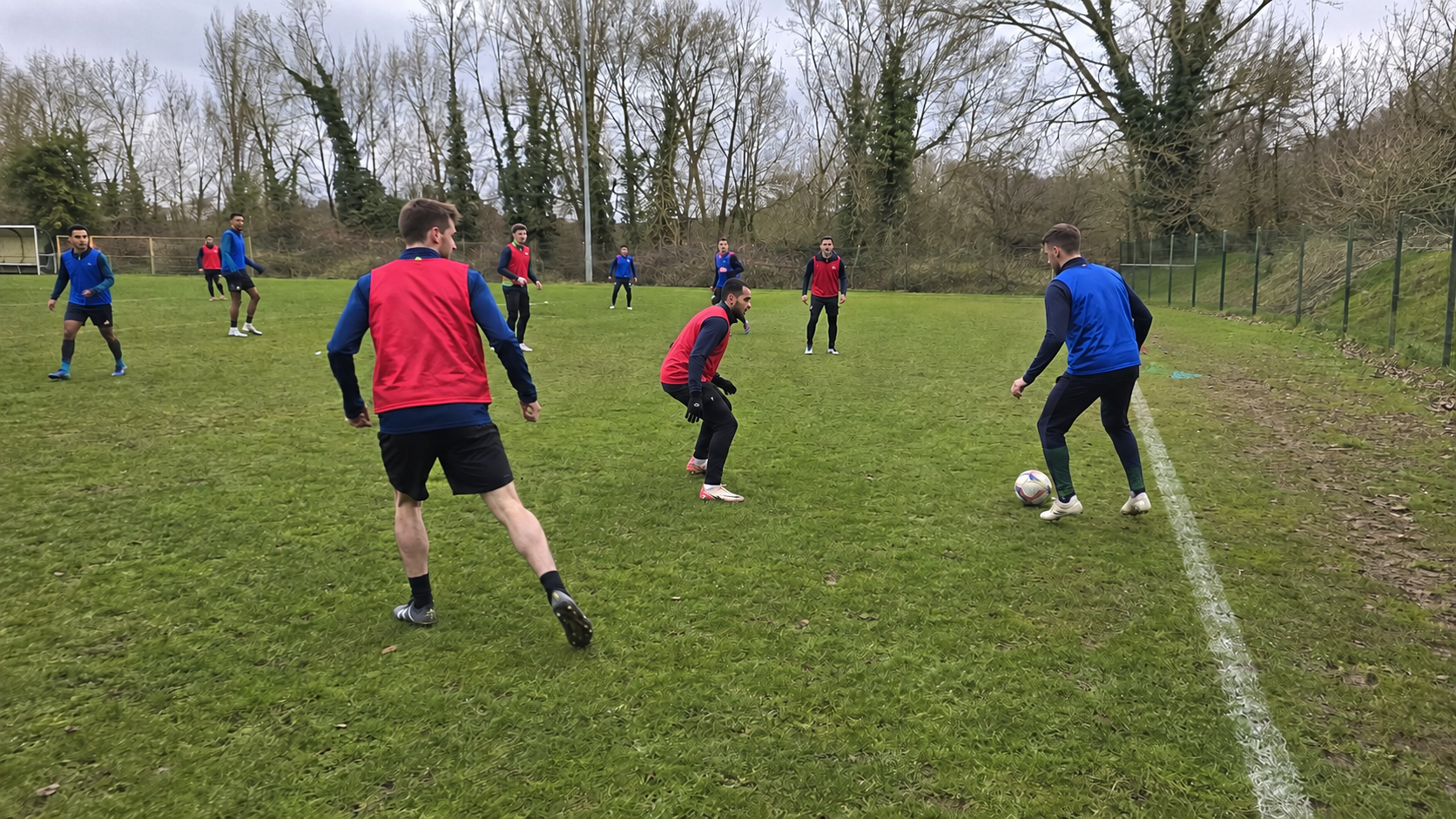
Wide areas are ideal for organising pressing traps because the touchline limits the ball carrier’s space and available options.
However, a pressing trap is not simply about running aggressively towards an opponent. The team must guide the opposition wide and then collectively close the available solutions.
The principle is simple:
Invite the opponent towards the touchline and prepare to regain possession there.
Why are wide areas effective?
In central areas, a player can pass in several directions. Near the touchline, their options become more limited.
The touchline acts as an additional defender because it:
- limits the player’s movement;
- reduces the available passing angles;
- makes it easier to isolate the ball carrier;
- helps the pressing team create a local numerical advantage.
The objective is to guide the opponent wide and progressively reduce the available space.
How do we prepare the trap?
The trap begins before the ball reaches the wide area. The striker and midfielders protect the centre while intentionally leaving the pass towards the full-back visible.
When the pass is played, the players accelerate while the ball is travelling:
- the nearest player presses the ball carrier and blocks the route inside;
- the striker closes the backward pass;
- the midfielder protects the inside option;
- the full-back steps forward to support the pressure;
- the defensive line advances and maintains compactness.
The apparently open pass is, in reality, an invitation into the prepared trap.
Pressing triggers
The pressure can be intensified following:
- a slow pass towards the outside;
- a poor first touch;
- receiving the ball with the back to play;
- a pass onto the weaker foot;
- the isolation of a player near the touchline;
- the absence of a nearby option inside.
The reaction must begin before the opponent controls the ball and looks up.
Protecting against a switch of play
Concentrating players in one wide area can leave the opposite side open. To prevent a switch of play, the ball carrier must face genuine pressure, while the players on the far side move towards the centre.
If the opponent has time to look up, they may play a diagonal pass over the pressure. For this reason, the defensive line must advance and the team must remain compact.
After Regaining Possession
Winning the ball in a wide area can create an immediate attacking opportunity. The team must quickly decide whether to:
- attack the goal;
- play towards a free teammate in the centre;
- retain possession through a safe pass.
The trap becomes truly effective when the recovery is transformed into progression or a goalscoring opportunity.
Common mistakes
The main mistakes include:
- pressing from the wrong angle and allowing the opponent to move inside;
- reacting too late;
- leaving the backward pass open;
- failing to protect the opposition’s pivot;
- excessive distances between players;
- the defensive line advancing too late;
- being unprepared for a switch of play.
Intensity without coordination creates pressure that can be bypassed easily.
Conclusion
Wide pressing traps transform the touchline into a defensive advantage. The team protects the centre, invites the pass wide and collectively attacks the opponent’s available options.
The message to the players should be clear:
Guide the opponent towards the touchline, reduce their options and regain the ball together.
An effective trap begins before the opponent receives the ball, by directing them towards the area where the team is prepared to intervene.